Tyranny of the Urgent | Book Review
“Your greatest danger is letting the urgent things
crowd out the important." (p. 5)
Charles E. Hummel's brief, yet timeless classic is worth revisiting during an age when we are constantly bombarded with interruptions 24/7. Note: Hummel makes repeated biblical scripture references throughout his work.
Interestingly, Hummel quotes A. E. Whitham:
"Here in this Man is adequate purpose ... inward rest,
that gives an air of leisure to His crowded life." (p. 9)
In a contemporary context, we can say Whitham is describing the calmness of someone with a well-balanced work/life rhythm, not unlike many such aspirational statements heard when sharing a Personal Leadership Philosophy (PLP).
In our Academy Leadership Setting Leadership Priorities workshop we use a variant of the classic Covey Time Management Matrix:
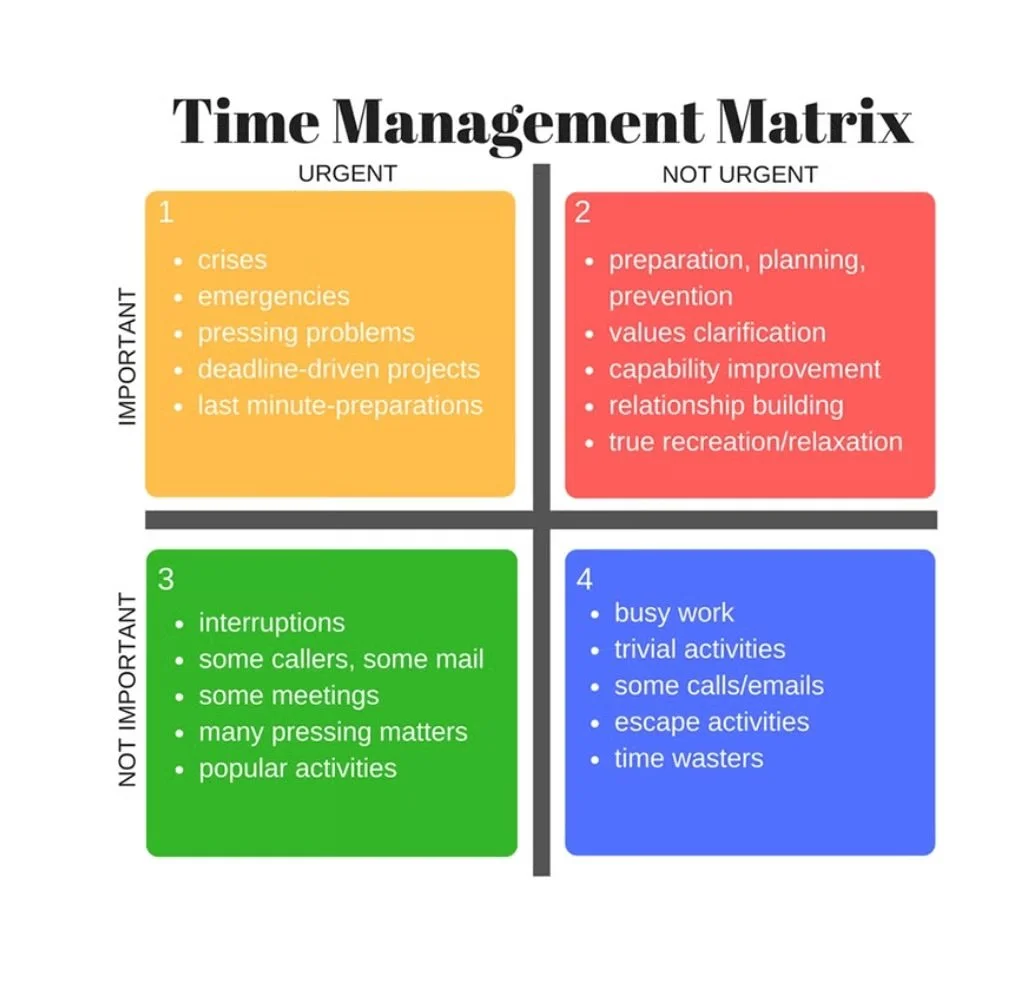
This review discusses the competing terms urgent & important and challenges us to regain agency based on our priorities as leaders.
Tension
When we audit and list daily activities in Quadrant I (Urgent and Important) and Quadrant II (Not Urgent and Important), we feel discomfort as the first quadrant fills. It's because we live in constant tension between the urgent and the important (p. 5). Sometimes when facilitating the Priorities workshop, some attendees even seem to like being in Quadrant I, perhaps mistaking busyness for fulfillment.
In fact, everyone has all the time there is -- twenty-four hours a day. But what an astonishing variety in our use of that time and the results of our choices! (p. 14)
Leader Application
Hummel describes a four step process:
• Decide What's Important (p. 17)
Consider a leader definition of what is important. It may be attention to family, co-workers, personal health and happiness. Not just work. Use broad brushstrokes.
• Discover Where Your Time Goes (p. 19)
In our Priorities workshop, we list activities in each of the four quadrants. Usually during this workshop, we'll feel a bit frustrated or angry when listing items in Quadrant Three. Why is that? Maybe we're too easily distracted or too reactive to interruptions. We may even fall prey to deception, or when someone else projects their (sometimes false) urgency onto us.
• Budget the Hours (p. 22)
Consider one high priority item for which more time needs to be budgeted (p. 23). In our Priorities workshop, we identify High Payoff Activities (HPAs), or effective activities that produce about 80% of our positive results. We should hopefully be discovering that our HPAs largely occupy Quadrant II.
• Follow Through (p. 24)
Maybe start with spending more time on our neglected HPA and defending the increasing activity budget. A competent general is prepared to change his plans if necessary to cope with an unexpected turn of events (p. 25). We should capture our stories and progress in our journal.
Quadrant II
In most Priorities workshops, participants undervalue the significance of the Not Urgent | Important Quadrant II. Think of Whitham's reference to leisure or the natural intuition of children. Our biggest personal & professional opportunities, love of life-long learning, dreams and aspirations belong here. Even better, consider creating a separate Quadrant II Journal.
Summary
There are two opposite ways to use our time. One person goes through the day responding mainly to inner compulsions and outward pressures of the moment (p. 29). The other person seizes their agency. "One minute spent in planning saves three or four minutes in execution." (p. 27).
"When we stop long enough to think about it,
we realize that our dilemma goes deeper than shortage of time;
it is basically a problem of priorities." (p. 4)
JE | November 2026
