
The Character Edge | Book Review
“Now colleges and universities, along with the military and
private corporations, are systemically integrating character
assessment and development into how they select, educate,
train, and develop their students and employees (p. 5).
Subtitled Leading and Winning with Integrity, this work merges the military excellence experience of Lt. General Robert L. Caslen, Jr. (ret.) with the academic excellence experience of Dr. Michael D. Matthews, Professor of Psychology, West Point. The pair define character as:
"a person acting on his or her world in ways that benefit it and, in turn,
the world thereby providing benefits for the person (pp. 7-8).
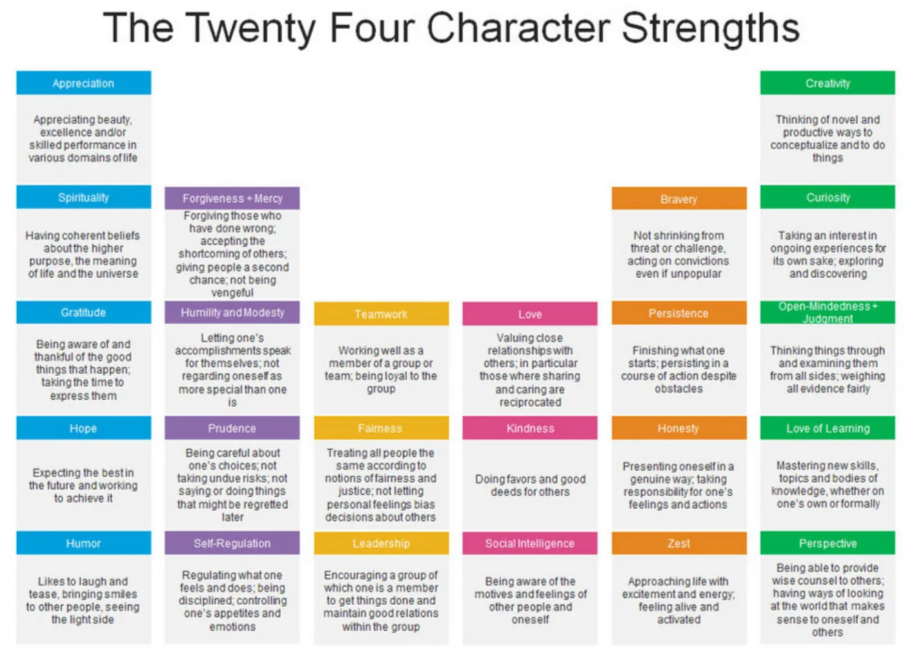
The Character Edge opens by referencing Seligman and Peterson, who identified twenty-four character strengths that are common in the human species, and further classify these into six overarching categories called moral virtues (pp. 11-12):
• wisdom and knowledge
• courage
• justice
• humanity
• temperance
• transcendence
This review recommends The Character Edge as an effective reference for developing an authentic Personal Leadership Philosophy, or PLP. This may be done in two ways: Using a Character Strengths Survey and aligning the top character findings with an Energize2Lead (TM) (E2L) Profile. Selected examples of both military experience and measurement & experimental design complete are also highlighted.
Assess | Character
Two character strength assessments may be used -- the first may be found on pages 13-16. Peterson and Seligman provide a second, more systematic way of assessing character strengths -- the Values-in-Action Inventory of Strengths (VIA-IS), which may be found on-line at no charge (p. 16):
VIA Survey of Character Strengths
Choose one and complete the survey. Peterson and Seligman believe it is particularly instructive to look at your top five or six strengths, which they refer to as signature strengths (p. 16). Note that the six columns, from left to right, correspond to the moral virtues transcendence, temperance, justice, humanity, courage, and wisdom and knowledge, respectively.
Source : https://www.linkedin.com/pulse/do-you-have-character-strengths-ray-williams-rdfec/
We can think of the signature strengths as our personal values, or what we believe in, as an essential starting point drafting our leadership philosophy.
Align | Energy
Caslen and Matthews recommend we keep in mind that we intuitively turn to specific strengths of character depending on the situation in which we find ourselves (p. 17). Recall from our E2L Workshop that we may think of our intuitive tendencies as the colors in the instinctive (lower) dimension of our profile; or our motivational needs, our learning style, our survival instincts, and what we tend to listen for.
Let's return to our personal values, or signature strengths and put them to the test. Are these the primary traits we turn to when tested, or under stress? If the answer is no for any of our top survey results, we should consider selecting another strength.
Lead | Live Our Strengths
The authors break down individual and organizational attributes vital to effective leadership into character strengths of the head, heart and gut -- respectively pertaining to good thinking, compassion for others, and courage (p. 23). These three character strengths comprise three central chapters of the book, or how to walk the talk. Key examples follow:
Strengths Of The Gut (Courage)
Psychologists Paul Lester and Cynthia Pury point out three factors that must be present of an act to be considered courageous (pp 29-33):
• Free Choice (Volition)
• Noble or Worthy Goal
• Significant Personal Risk
The authors highlight, among others, Captain Barry Bridger, a Vietnam War F-4 Phantom fighter pilot who was shot down 23 January 1967 and endured 2,232 days as a prisoner of war (POW). His Silver Star citation illustrates what he endured while recognizing his character strength of devotion to duty to enable him to persevere under such conditions (pp. 26-27).
Strengths Of The Head (Good Thinking)
Psychologist Robert Sternberg found that overall intelligence breaks down into three subtypes: analytical, creative, and practical. Another psychologist, Howard Gardner, identified eight (more specific) types of intelligence: linguistic, logical-mathematical, spatial, musical, bodily-kinesthetic, interpersonal, and naturalistic (pp. 58-59).
Caslen reflects on second lieutenant Sam Ketchens, who the general knew as a rugby player at West Point and successfully integrated the Sons of Iraq into the Iraqi Army by negotiating, reasoning, and winning the support of his Iraqi Army counterparts and got these former insurgents the support, equipment, and rations they needed (pp. 66-67).
Strengths Of The Heart (Compassion For Others)
Cultural anthropologist Janice Harper writes:
"If a man (Nelson Mandela) tortured and imprisoned for nearly
three decades could find in himself forgiveness, what lessons
might we take from him on how to respond to acts of
aggression and cruelty in our ordinary lives?" (p. 92)
The authors call out Gratitude as one of the most powerful strengths of the heart: The greatest thing about gratitude is that practicing it may bring greater positive benefits for you than it does for the recipient of thanks (p. 93).
Dr. Matthews recalls mentoring a cadet who had been arrested for driving while intoxicated, and rather than separation from West Point, was placed in a formal and rigorous mentorship program. A few days before the cadet's graduation he penned a deeply meaningful letter of gratitude (pp. 93-94).
Summary
The best evidence that we are authentically living our leadership philosophy is when our stories accumulate over time, just as with Caslen and Matthews.
Character must be continuously developed. It is not something you
have or don't have. Even people considered to be icons of character
sometimes fail to behave morally or ethically (p. 184).
LTG Caslen generously provided a copy of his book for review.
JE | February 2026
