
Of Human Interaction | Book Review
“Openness to the world implies a developed and ever-growing state,
an experiencing, doing, enjoying, struggling, changing, creating,
dreaming, agonizing, renewing, problem solving, appreciating state
of being with self and others." (p. 22)
is Joseph Luft's seminal 1969 work which is shared in Academy Leadership's Feedback - The Essential Connection workshops. Luft's basis for division into quadrants is awareness of behavior, feelings, and motivation (p. 13). In our workshops, the Arena is quadrant one, the Blind Spot quadrant two, the Facade quadrant three, and the Unknown quadrant four.
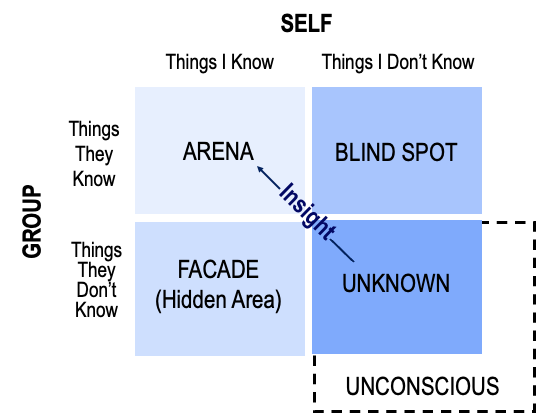
Source: Academy Leadership Feedback - The Essential Connection Workshop
The name Johari, which is pronounced as if it were Joe and Harry (p. 6), is based on Luft's collaboration with Harry Ingham of UCLA. This review explores the original basis for the Johari Window and comments on the author's five leadership archetypes which are based on particular uses of the window.
The Open Area | Q1 | Arena
Luft lists eleven principles of change (p. 14):
1. A change in any one quadrant will affect all other quadrants.
2. It takes energy to hide, deny, or be blind to behavior which is involved in interaction.
3. Threat tends to decrease awareness; mutual trust tends to increase awareness.
4. Forced awareness (exposure) is undesirable and usually ineffective.
5. Interpersonal learning means a change has taken place so that quadrant 1 is larger, and one or more of the other quadrants has grown smaller.
6. Working with others is facilitated by a large enough area of free activity. It means more of the resources and skills of the persons involved can be applied to the task at hand.
7. The smaller the first quadrant, the poorer the communication.
8. There is universal curiosity about the unknown area, but this is held in check by custom, social training, and diverse fears.
9. Sensitivity means appreciating the covert aspects of behavior, in quadrants 2, 3, and 4, and respecting the desire of others to keep them so.
10. Learning about group processes, as they are being experienced, helps to increase awareness (enlarging quadrant 1) for the group as a whole as well as for individual members.
11. The value system of a group and its membership may be noted in the way unknowns in life of the group are confronted.
At first glance, the Arena seems similar to the concept of Dialogue, as described in Crucial Conversations: The free flow of meaning between two or more people. Knowledge, skill, awareness, and pleasure are determined by the magnitude of the first quadrant (p. 17).
Luft goes further than the concept of dialog, repeatedly mentioned the value of knowing oneself. Repeatedly, people report how good it feels to be in touch with oneself (p. 21). In his own way, he is advocating for rich meditation, reflection and journaling.
The Blind Area | Q2 | Blind Spot
Having blind spots about my own behavior means that I am eternally vulnerable to others (p. 27). Perhaps leaders reluctant to submit to a 360 review should consider what may happen if we don't embrace a commitment to feedback.
Luft tells the story of a technical professional who was not very happy to learn these things about himself, but he came to realize they were accurate perceptions of his behavior which must have affected not only the strangers in the group but his colleagues at work, as well as his family and friends back home (p. 28). This tendency aligns with the propensity of the Subject Matter Expert's typical pattern of evaluating much more than coaching. We tend to pigeonhole each other very quickly and then to search for confirmation of our own stereotyping (p. 31).
In the course of any interaction our blind areas show themselves to others in characteristic ways. We distort or forget or exaggerate things; we overreact or underreact. We say gauche things, or we don't hear things. We imagine something is intentional when it is not and we laugh in the wrong places (p. 35).
Examples of feelings and needs difficult to face (p. 36):
1. Feelings of inadequacy, incompetence, and impotence.
2. Sensitivity to rejection or affection.
3. Need to punish or be punished.
4. Guild-laden and depressive moods.
5. Passive-dependent feelings, especially in men and in women who have high achievement aspirations.
6. Intense feelings of loneliness and isolation.
7. Conflicting feelings for loved ones.
8. Powerful needs to control or manipulate others.
9. Qualities in the person that he cannot tolerate in others.
10. Feelings of unworthiness and despair.
Luft playfully shares that it's rather simple to annoy your friends and relatives. Just tell them something about themselves of which they are not aware (p. 41). Who enjoys unsolicited feedback?
The Hidden Area | Q3 | Facade
What is known to self and not known to others is the private realm. Here discretion reigns (p. 45). Luft delineates four sources of difficulty in communicating, ranging from relatively simple to more complex (pp. 47-51)
1. Lack of clarity of language.
2. Information, attitudes, and opinions remain hidden because of unfinished interpersonal work.
3. Your behavior, feelings, and motivation are open to others but not to you: what you do and say in Q1 may be different from and perhaps even contradictory to what others perceive in Q2.
4. Problems frequently concerned with intrapersonal communication. Imagination, fantasy life, daydreams, and nightdreams impinge on the individual and influence his thinking and feeling.
Sharing a Personal Leadership Philosophy seems an ideal antidote for minimizing the listed communications barriers. In particular, sharing pet peeves and idiosyncrasies may help with the more difficult third and fourth sources.
Luft introduces the neologism parallaction, which may be of use to describe the behavior in a relationship in which persons are in touch with one another but are acting, living, and moving independently, rather than interdependently (p. 55). The new term seems the opposite of engaged, or better yet, of the word meaningful. It sounds a bit like the term Switchback Conversations, from Thanks for the Feedback. Neither brings parties closer together.
The Unknown Area | Q4 | Unknown
The size of quadrant four in relation to the other quadrants in not directly knowable, but it is much larger than the area usually indicated (p. 65). A sizeable Q4 seems a symptom of many issues. Given the reluctance of many leaders to request and receive feedback, perhaps a recommended exercise would be comparison of two Johari Windows, one performed by a leader describing his or her relationship with their group; the other performed by the group describing their relationship with the leader.
One responsibility of the leader and eventually of the other participants in a learning group is to provide simple occasions which are fresh and new for the participants so that they may enjoy seeing themselves perform unpracticed behavior (p. 73). Addressing differences between the two respective Johari Windows would be a great place to start.
Influence
Whoever takes responsibility for influencing others through interpersonal behavior may be understood as a leader (p. 99). Luft describes five type of leaders:
Shaman
In Johari terms, the shaman calls attention to himself by what he skillfully reveals, Q3 to Q1 (pp 99-100). This type of leader is likely extroverted, confident and dramatic. The shaman may fail with followers who have their own narcissistic problems (p. 100).
Mystic
The mystic leads, teaches, or heals by seeking out hidden sources of weakness and of strength in his followers (p. 101). We may think of the mystic as the Socratic teacher, carefully drawing out insights from the group. His followers come away enriched or strengthened and with a feeling of confidence in this type of leader (p. 102).
Naturalist
As a leader, consultant, teacher, or healer, the naturalist is essentially realistic, factual, and impersonal (p. 102). This type of leader very likely has dominant green and dominant red Energize2LeadÒ colors and sees things as black and white. The third quadrant is his storehouse of knowledge and skill to be drawn upon as necessary (p. 104).
Priest
In the priestly model, the leader, consultant, or trainer works closely with his follower, instructing him explicitly, but frequently implicitly, in all aspects of life (p. 105). A contemporary manifestation of the priest may be the numerous professionals declaring themselves "life coaches" today.
Magician
The magician sets up his own work conditions with which no one must interfere (p. 106). Think of the eclectic, yet super charismatic personality attracting huge crowds today. The magician's reputation is widely accepted by the audience. The follower is more passive and dependent during the ritual (p. 107).
Summary
How the individual comes to terms with the significant unknowns in his life is crucial to the qualities in his system of personal values (p. 146). Feedback matters.
At the core of human interaction is the experience
of "really feeling understood." (p. 143)
Thank you Mark Maxwell, for introducing the book.
JE | October 2025
