Influence & Insight | September 2026
Influence & Insight | August 2026
Leadership Story | Start With Why
In our Academy Leadership Aligning & Accomplishing Goals workshop, we conduct a self-reflection exercise called Life’s Compass Rose. Participants are asked to rate their personal satisfaction levels in sixteen dimensions. One of the most common questions during the exercise is “What is the difference between Purpose & Mission?“
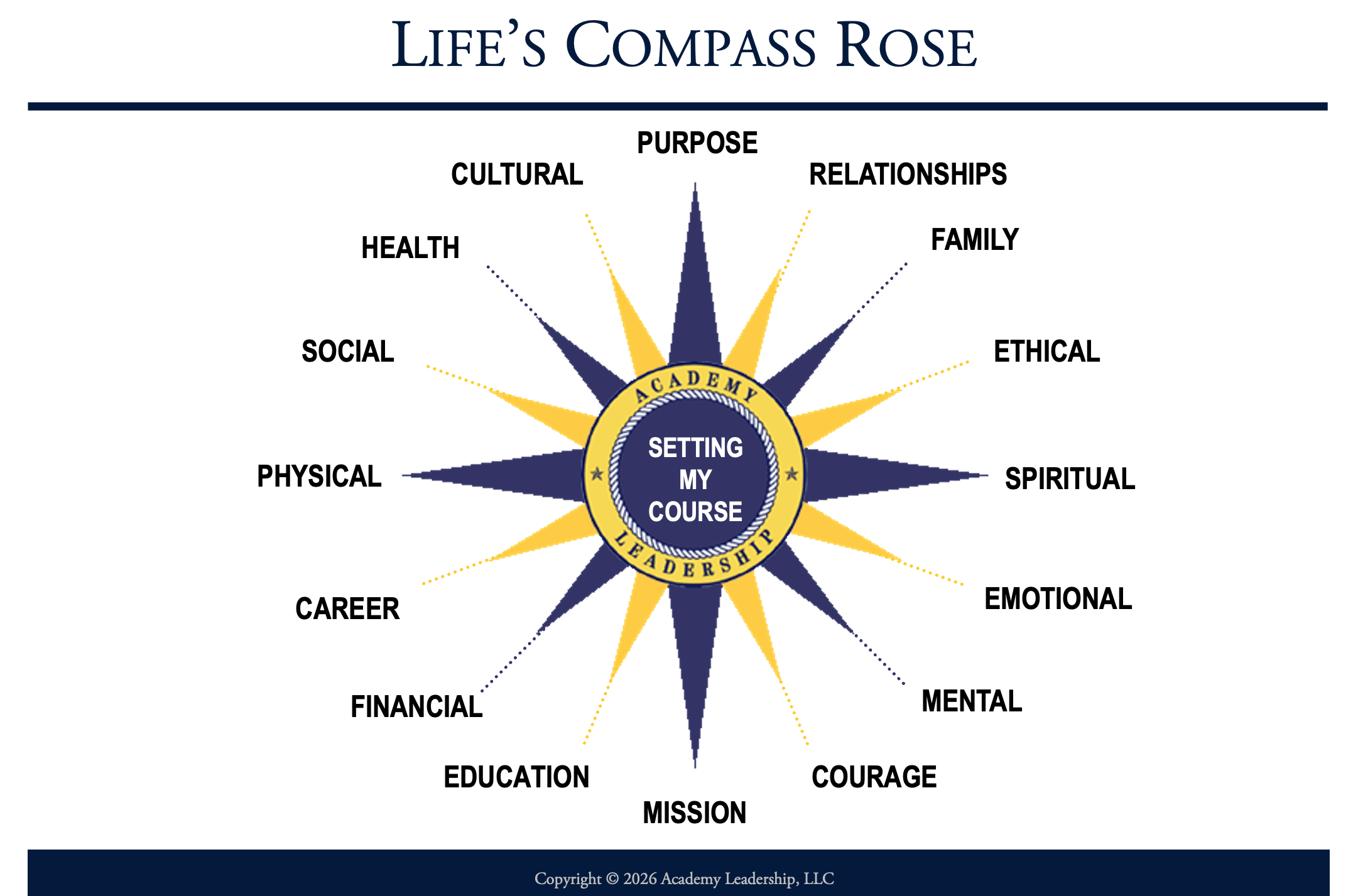
Simon Sinek gives us a useful starting point: Start With Why. We live in an environment where many things are competing for our attention. It’s worth occasionally ignoring all the distractions around us and asking basic questions such as: Why am I here? What will be my enduring legacy? What can I do that will be significant? We can think of this as our Leader’s Compass or our North Star. Our purpose shouldn’t need to change much.
Our Mission is our How. From our leadership philosophy, we may think of this as our operating principles, followed by more specific actions. We may seek certain roles which will allow us to complete our mission. Unlike our Purpose, our Mission may change or adapt over time.
If we are struggling with defining our purpose, we may explore two things as a start. What are my values and what genuinely energizes me? We may then share our thoughts with someone who knows us well and can provide valuable feedback.
Start With Why.
Between Grief and Grit | Book Review
“Someone's watching for your glow. Shine it into your home,
your team, your community. Be the steady beam that
helps someone else find their next best step in the dark." (p. 114)
Brooke Britain's penetrating personal story, subtitled A Flashlight for Leaders Navigating the Dark, demonstrates the power of an authentic leadership philosophy. Take a look at the detailed acknowledgements starting on page 115 first, as it's clear Britain gathers stories from all chapters of her life.
An effective Personal Leadership Philosophy, or PLP, is one that speaks from the heart and exposes vulnerability. Britain's PLP is grounded in what she calls
The Warrior's Triangle: The grit to fight, the people to hold the line beside you, and the faith to believe you're not fighting alone (pp. 1-2).
This review makes the case that the three sections of Between Grief and Grit, through a range of heartfelt stories, inform us what Britain's philosophy is, and more importantly, how it was forged.
The Light
To Britain, leadership means being present. This means overcoming self-doubt when we don't have all the answers. What feels monstrous, terrifying, and overwhelming in the dark is often just misunderstood in the light -- distorted, magnified, or stripped of its true form (p. 19). Leadership is not about us. You're expected to be the strong one and carry other's people's grief, steady the ship, and show up like you're OK -- even when you're not (p. 33).
Strong feelings of combat guilt haunted Britain for a long time. If I had just feels noble because it mimics accountability (p. 26). After deep reflection, she realized Should have and Could have do not exist. I no longer carry If I had just as my story. I carry the truth. I was there. I did my best. I loved. And that is enough (p. 27). She's sharing what others can expect of her as a leader.
One of Britain's operating principles is to reconnect when disruption occurs. Reconnection begins the same way disconnection did -- quietly, one choice at a time (p. 42).
• One honest conversation.
• One moment of eye contact.
• One act of service.
• One small display of gratitude.
The Dark
Britain correlates negativity and danger with the dark and was trained to look for it. Instead of seeing all the good things I could enjoy around me, I started seeing threats first. In Iraq, that wiring kept me alive. At home, it kept me braced for impact in rooms where there was no actual danger (p. 51). What was necessary in Iraq wasn't helpful in civilian life.
Negativity bias will try to convince you that every unknown shape is an enemy. But the more you turn on the light, the more you realize half the things your feared were never coming for you in the first place (p. 55).
A good way to describe a PLP is our own compass. Britain realized her compass is determined by her attitude and values (p. 59), and that we each have agency. Attitude is about deliberately choosing (p. 60):
• Gratitude over cynicism
• Courage over fear
• Service before self
• Optimism over pessimism
• Hope over despair
• Belief over doubt
• Encouragement over discouragement
One of hers core values is Integrity: Something I protect, something I maintain, something I repair (p. 71). It's a work in progress, reflecting our imperfect human condition.
Britain's four S's (pp. 79-80), may be considered her daily priorities:
• Sweat
• Spirit
• Substance
• Sleep
The Fight
While overcoming cancer, Britain comes to understand how overarching her core value of optimism has become:
She's aligned with Dr. Jim Brennan (p. 91):
"Relentless optimism is a response to adversity that
can be both highly aggressive and stubbornly positive.
The purpose of life is to go forward."
Optimism is not fuzzy, amorphous, or squishy. For too long, we've confused toughness with tension and grit with grimness (p. 95).
That's why optimism isn't a soft skill. It's a combat skill. (p. 96)
Similar to Anders Ericsson in Peak, Britain deliberately moves ahead. The way to win is the sum of continuously taking the next best action again and again -- after failure, after mistake, after loss (p. 111).
Summary
Britain has essentially composed her PLP from the heart. It's a reminder that we should do the same, capturing our deepest, most authentic stories.
"Most people never stand in a combat zone. Most leaders never carry
a rifle. But every leader knows what it is like to have people
counting on them when they're running on fumes." (p. xii)
Thank you Brooke for sharing both your book and your personal story.
Coaching Story | Invest in People Early
After a recent ChoinqueCast interview, it seemed a good idea to invite my new colleague to a three-day Leadership Excellence Course. Perhaps the young company president, now 27 years old, reminded me of thirty four years ago as a 28 year old company co-founder. It’s easy to rely on your gut at that age, and it certainly takes confidence launching a company from nothing. It doesn’t mean we actually know what to do though.
A very grateful email followed the course:
“Thank you once again for encouraging me to take this class. I have always been someone that naturally finds myself in a leadership position, but never had any education on any techniques to be my best. I've always been kind of guessing what to do, based off of what felt right. The class really opened up my eyes to a lot of different techniques and showed me different perspectives about how to encourage and motivate others.”
Guess what. A great many of us are put into management or leadership roles without any training. The email continues highlighting new tools now in my colleague’s toolbox:
“While I am still building a full plan, I did act right away and made some small immediate changes in my Monday operations meeting. I opened the meeting with my 2-2s. I told my team a little bit about what I learned in class and about myself. I told them how important feedback is and how I want to create a coaching culture. I asked them all what they were personally looking forward to in the year, which turned into a more uplifting start to the meeting. One, even said how he is looking forward to building his team up and developing their skills. I then asked them what they felt like the intent of the meeting was, as it has always felt like they met for me, because I told them to. Posing that question to them, I believe generated great engagement. Suddenly we were having richer conversations about pain points with scheduling and I didn't have to call on each person to get them to participate. Wow! I couldn't believe how alive it was.”
Fantastic. Lesson learned: People want leaders as coaches, not bosses. To learn this at 27! Another great takeaway:
“My owner's meeting following right after and they loved my new approach to leadership, and we just naturally spent 2 hours asking each other questions about how we feel is best to develop our employees further. We concluded with a list of questions I am going to bring up in each employees' one-on-one sessions. We've always had the approach of telling these guys how to operate, but I feel by asking them questions we are going to help them come to their own conclusions about how to develop their teams and overcome some of the problems that I have always tried to figure out that they should have been all along.”
Motivation matters. Look for way to empower and develop your team.
Finally, little things make a big difference.
“Such a small change had such a drastic effect on these meetings and I am so amazed. These meetings were by far the most engaged I have ever had and I felt like had the most positive outcomes from them. I can't thank you enough! I am full believer that leadership is going to help us break through the wall we have been hitting for years. I already feel a lot more motivated to work on our company more by just getting this feedback from them.”
Invest in People Early.
Influence & Insight | July 2026
Leadership Story | Meaningfulness Matters
Justin Lahart wrote a recent WSJ piece Work From Home Is Here to Stay — Even if Some CEOs Don’t Love It (behind paywall).
Lahart shares that the past couple of years have seen a drumbeat of big companies announcing, to great fanfare, that they were requiring employees to spend more time in the office. Home Depot, Target, Microsoft, 3M, Intel—the list goes on and on.
The reality:
“I come in, and—where is everybody else?” complained JPMorgan Chase Chief Executive Jamie Dimon in a recording that leaked to Barron’s in early 2025. The bank required its employees to come back to the office five days a week starting in March last year.
An average of 26% of paid, full days were worked from home in May, according to a monthly work-from-home survey run by economists Jose Maria Barrero, Nicholas Bloom and Steven Davis. That is down, but not by much, from the 27% registered two years earlier.
Interestingly, in Rick Lynch’s We’re Not Robots, he shares Jamie Dimon’s sentiment, via Chapter 12 | The Imperative to Return to Work.
This position may be generational. Lahart cites Bloom, a Stanford University economist, who points out that many of the chief executives who run big companies are on the older side. In recent survey work, he and his co-authors found that employees at companies with young chief executives worked from home more frequently than companies with older executives at the helm.
“If you look at CEOs who were 40 or under during the pandemic, they’re far more likely nowadays to have at least hybrid in their companies,” Bloom said. “Older CEOs generationally are just less used to it.”
Rather than reading about the largest US companies, perhaps we should be looking for next-generation companies poised to become tomorrow’s larger ones.
Nor is it just younger CEOs who are more receptive to work from home. The same is true of younger companies, noted Prithwiraj Choudhury, an economist at the London School of Economics. This matters because historically, job growth in the U.S. has been driven not by well-established companies but by smaller startups on their way to becoming tomorrow’s behemoths.
“These are the companies which are investing in management practices to make this model work, and some of these companies will scale up and become the next set of large companies,” he said.
Ultimately Lynch concluded that in order to entice workers to want to come into the office and contribute face to face again, leaders will have to be adaptive in terms of constructing that work time. Lynch calls this adaptive leadership. Recall in Culture Shock, Team Gallup summarizes we should hold one meaningful conversation per week with each employee. Adaptive and meaningful appear the same.
Leadership is not about monitoring attendance. That’s compliance.
Meaningfulness Matters.
We're Not Robots | Book Review
“In whatever kind of a company you're leading or working for,
you've got people's lives in your hands every day." (p. xxv)
Lieutenant General Rick Lynch's (U.S. Army, retired) contemporary observations of Corporate America tie very closely to Academy Leadership workshops & assessments. With the advent of disruptive Artificial Intelligence (AI), it's worth pointing out that robotic activities are the most replaceable, while leading people, who are not robots, remains a timeless opportunity.
This review maps most of Lynch's chapters to specific workshops and assessments then emphasizes that prioritizing High Payoff Activities (HPAs) inevitably leads to High Performance Organization (HPO) creation.
Personal Leadership Philosophy
When challenged to compose a first draft Personal Leadership Philosophy, or PLP, reluctance to open up or share internal beliefs usually leads to a sense of vulnerability. Lynch puts it this way: We've put up a sort of "church-and-state" type wall in Corporate America, with this false idea that work is work, and life is life, and those two things should never be intertwined (p. 10).
Lynch is correct. If they don't feel that a company cares about its people, they'll walk (or run) to work somewhere else, or they won't bother taking the job in the first place (p. 16). People are naturally drawn to a sense of purpose. Shared purpose, well-defined values, and a unified culture are found at the very foundation of every High Performing Organization (p. 20).
Unity doesn't seem to get enough emphasis today. Having a list of established values gives you the ammunition you need to enforce the types of behavior you want your organization to uphold (p. 23). We may then consistently communicate and reinforce what our enterprise is all about and then construct a leadership pipeline for continuity. It's easy to skip the latter step. When it comes to my observations of clients who are failing, each and every one of them is failing to invest in their leader development (p. 45).
Feedback | Assessments
Probably the easiest way to assess a team of leaders is to ask about internal assessment processes, especially how the leaders welcome external review such as a 360 assessment. You'd be surprised how many of them push back and don't want to do it (p. 52). When this occurs, it's a likely sign that evaluation and coaching are not employed as separate forms of feedback. If we think of a performance review as the evaluation and the follow up as the coaching toward improvement, then we're building a culture of continuous development. So we've got to quit fooling ourselves and thinking that it's okay to tolerate poor performance (p. 133). Effective leaders articulate expectations in a PLP, while simultaneously championing both individual and organizational growth.
Leader as Coach
On page 152 Lynch shares his personal discovery of deliberate practice leading to his improved golf game. Recall from Peak, deliberate practice:
• Develops skills that other people have already figured out how to do and for which effective training techniques have been established
• Takes place outside one's comfort zone and requires a student to constantly try things that are just beyond his or her abilities
• Involves well-defined, specific goals and often involves improving some aspect of the target performance
• Requires a person's full attention and conscious action
• Involves feedback and modifications of efforts in response to that feedback
• Both produces and depends on effective mental representations
• Nearly always involves building or modifying previously acquired skills by focusing on particular aspects of those skills and working to improve them specifically
Lynch's Routine Counseling Form on page 123 is largely the same as an Academy Leadership Coaching Form. It's possible counseling may sound more therapeutic than performance coaching.
In Chapter 12, The Imperative to Return to Work, Lynch reveals his personal preference. However, he notes: In order to entice workers to want to come into the office and contribute face to face again, leaders will have to be adaptive in terms of constructing that work time (p. 186). Lynch calls this adaptive leadership. Recall in Culture Shock, Team Gallup summarizes we should hold one meaningful conversation per week with each employee. Adaptive and meaningful appear the same.
High Payoff Activities (HPAs) | HPOs
In our Setting Leadership Priorities workshop, we define High Payoff Activities (HPAs) as answering:
• What are you being paid to do?
• What do you do that produces the greatest results?
• What do you do that makes your company profitable?
• Why did the company hire you?
• What do you do that produces 80% of your results?
Lynch notices that many are not focused on HPAs. It's, frankly amazing to me the number of things that workers in Corporate America have on their plates that do not need to be there (p. 170). It's hard focusing on HPAs without delegating, especially if we're an accomplished Subject Matter Expert (SME). You cannot be an effective senior leader if you're trying to do it all yourself (p. 217).
By living our PLP, we'll build trust. Once you've built a foundation of trust, then you're free to get to the good stuff (p. 211):
• The ability to delegate
• The ability to foster teamwork and collaboration
• The ability to adapt and innovate
We may describe the above as Leader as Coach behaviors or traits. Once you're acting in full-time HPO mode, then the organization can take on the traits of a strong Strategic Leader (pp. 241-242):
• Observe and seek trends
• Sound strategic when they speak
• Ask the hard questions
• Take time to think and embrace conflict
Summary
Now is not the time for fearing robots, it's time to celebrate our humanity.
"Robots don't exhibit empathy. We cannot expect robots to lead.
And we cannot expect our people to perform like robots
if we ever want them to excel as leaders, either." (p. 218)
Coaching Story | The Cost of Employee Turnover
In a recent coaching session with a very talented senior leader, I was informed that within a single, small department, there was 100% turnover in the last year. Seven of seven people.
We often read about the financial costs of high employee turnover, so let’s take a look at recent findings describing the lesser-quantified damage.
In The Real Costs Of Employee Turnover In 2026, Tyler Jadah
lists the less obvious and sometimes hidden costs that can really hurt:
• Lowered production and quality
• Loss of morale
• Loss of company knowledge
Jadah lists five factors leading to high turnover:
Factor 1: Lack of Employee Recognition
Factor 2: Inadequate Company Culture
Factor 3: Limited Growth Opportunities
Factor 4: Ineffective Management or Leadership
Factor 5: Compensation and Benefits Discrepancies
Carol Warner shares The Real Cost of Employee Turnover Now, also delineating between direct and hidden costs. She stresses the importance of calculating the hidden costs alongside the direct costs when considering the direct costs of employee turnover:
• Employee morale
• Productivity declines
• Knowledge Loss and Knowledge Transfer Ramp Up
Warner shares several employee retention strategies:
• Elicit Feedback
• Review Benefits & Perks
• Transparency
Recall in our Creating a Motivational Environment Workshop, we learn to understand the role as a leader in creating an environment where individuals and teams are motivated to accomplish the vision and mission of an organization. We cannot simply rely on whether or not we have a “cool place to work,” or presume we can easily replace employees form a long list of applicants without understanding the total costs, direct and hidden.
The Cost of Employee Turnover.
Influence & Insight | June 2026
Leadership Story | Start With Heart
One of the highlights of a Graduate Leadership Course (GLC) is facilitating the Advanced Leadership Communications workshop, which is largely focused on the popular Crucial Conversations book, now in its third edition. A major premise of Crucial Conversations is that dialogue, or the free flow of meaning between two or more people, is initially established via a shared pool of meaning, and that dialogue skills are learnable.
Edition three increased the number of dialogue skills to nine:
1. Choose Your Topic
2. Start with Heart
3. Master My Stories
4. Learn to Look
5. Make it Safe
6. State My Path
7. Explore Other Paths
8. Retake Your Pen
9. Move to Action
During a recent ten-person GLC, we posted the attendee’s dialog skills scores of zero (zero is lowest, two is highest) for everyone to see. What stood out immediately was that all ten participants scored zero on dialogue skill 2, Start With Heart. Let’s explore this dialogue skill a bit.
Start with Heart is all about sharing what we genuinely want, whether for a project outcome, a strategic result, or for a relationship. Thinking more about the ten GLC attendees, many of their E2L (Energize2Lead®) Profile dominant colors were green and blue, perhaps unassertive much of the time. By the end of our third day together, many in our cohort realized it’s ok to let others know what is important to us, especially when our motives are aligned with our organization’s core values.
Another realization is that we’re often presented with two seemingly opposing choices, which we can may call the Fool’s Choice or the Sucker’s Choice. Our children do this all the time: “Mommy if I can’t have [whatever], my life will be ruined.” The best way to avoid simply agreeing to the choice is using the inclusive ‘and’ in our response. We may counter with: “Is it possible to both have [whatever], subject to three conditions and have a happy life?” In that way both parties get what they really want by Starting With Heart and increasing dialogue.
Leaders Start With Heart.
The Art of Possibility | Book Review
“Now colleges and universities, along with the military and
private corporations, are systemically integrating character
assessment and development into how they select, educate,
train, and develop their students and employees (p. 5).
Book of the year.
Subtitled Transforming Professional and Personal Life, Rosamund Stone Zander (RIP) & Benjamin Zander's seamlessly flowing stories may be the best work advocating for an abundance rather than scarcity mindset penned.
"Our premise is that many of the circumstances that seem
to block us in our daily lives may only appear to do so based
on a framework of assumptions we carry with us." (p. 1)
Read the Coda first, starting on page 199. As with the nine dialogue skills forming Crucial Conversations, we may study and implement among the dozen most relevant practices.
Both authors, at their core, are deeply thoughtful coaches. This review groups the Zanders' twelve practices into four categories which may guide us from initially developing an improved mindset to becoming an effective coach.
Abundance Mindset
Stepping into a Universe of Possibility
Life in the measurement world seems to be arranged in hierarchies: some groups, people, bodies, places, and ideas seem better or more powerful than others (p. 19). We may think of the measurement world as a worldview endlessly comparing one thing, or ourselves, to another. This leads to the assumption is that life is about staying alive and making it through -- surviving in a world of scarcity and peril (p. 18).
It's All Invented
It's all invented is the most fundamental
of all the practices we present in this book.
Every problem, every dilemma, every dead end we find ourselves facing in life, only appears unsolvable inside a particular frame or point of view (p. 14). This reminds us of the fool's choice from Crucial Conversations, when we are pressured to unnecessarily choose between two widely different outcomes, or accepting...
The Way Things Are
The authors offer an antidote to hopeless resignation. It is to be present to the way things are, including our feelings about the way things are (p. 100). Let's think of our feelings as our perceptions, and how we may select a role, or story character based on our feelings, rather than actual reality
So, this part of the practice of being the way things are is to separate our conclusions about events from our description of the events themselves, until possibility opens up (p. 106). The result: You are more likely to extend your business and have a fulfilled life if you have the attitude that there are always new customers out there waiting to be enrolled rather than that money, customers, and ideas are in short supply (p. 21).
Personal Leadership Philosophy
Giving an A
An effective Personal Leadership Philosophy, or PLP, envisions a positive, unifying future we are drawn to. In the absence of a vision, we are each driven by our own agenda, finding people whose interests match ours, and inattentive to those with whom we appear to have little in common (p. 36). Giving the A connects others to our PLP. It both invents and recognizes a universal desire in people to contribute to others, no matter how many barriers there are to its expression (p. 39).
Being the Board
This practice is similar to an After Action Review (AAR), for both corrective actions and for continuous improvement. Choosing the Being the Board approach opens the possibility of a graceful journey, one that quickly reinstates us on the path we chose before the fateful collision intervened (p. 143). Avoid playing the blame game. Rather than assigning blame, get back on track, and resolve to improve together...
Telling the WE Story
Another successful PLP attribute is language that unifies teams, usually creating a powerful group identity. By telling the WE story, an individual becomes a conduit for this new inclusive entity, wearing it's eyes and ears, feeling its heart, thinking its thoughts, inquiring into what is best for US (p. 183).
Motivational or Instinctive Needs
Rule Number 6
The best leaders understand our fundamental, or instinctive needs. When these needs are not met, the calculating self is concerned for its survival in a world of scarcity (p. 81). As leaders, we should establish mutual purpose based on abundance and opportunity. We might want to steer away from a hierarchical environment of scarcity and deficiency and toward an attitude of wholeness and sufficiency (p. 90).
Giving Way to Passion
If we think of Maslow's Hierarchy of Needs, with survival conditions forming the base, all growth and development stops until our primitive needs are met. Accordingly, this practice has two steps: First to notice where you are holding back, and the second is to participate wholly (p. 114). We may then ascend to success and self-actualization. Life flows when we put our attention on the larger patterns of which we are a part. Life takes on shape and meaning when a person is able to transcend the barriers of personal survival and become a unique conduit for its vital energy (p. 117).
Lighting a Spark
The authors description of enrollment is much like Gallup's definition of engagement. Enrollment is the art and practice of generating a spark of possibility for others to share (p. 125). The better we know others, the higher chance of a successful outcome. So, the practice of enrollment is about giving yourself as a possibility to others and being ready, in turn, to catch their spark (p. 126).
Leader as Coach
Leading from any Chair
If we're helping someone, we're likely acting as a coach, even if we don't see ourselves as a leader. I had been conducting for nearly twenty years when it suddenly dawned on me that the conductor of an orchestra does not make a sound (p. 68). When we support and positively influence, we are leading. Leadership is a gift, shining silver, that reminds people huddled nearby why each shimmering moment matters (p. 74).
Creating Frameworks for Possibility
The most powerful coaching is based on abundance. Ask great questions. The foremost challenge for leaders today, we suggest, is to maintain the clarity to stand confidently in the abundant universe of possibility (p. 162). Avoid comparisons and us versus them mindsets. This new leader carries the distinction that it is the framework of fear and scarcity, not scarcity itself, that promotes divisions between people (p. 163).
Being a Contribution
Coaching is focused on positive growth, providing any tools or resources necessary. Unlike success and failure, contribution has no other side. It is not arrived at by comparison (p. 57). Encourage journaling. I explain that they should jot down anything they said or did that they are willing to call a contribution (p. 61).
Summary
At the core, leadership is about energy.
"The life force for humankind is, perhaps, nothing more or less than
the passionate energy to connect, express, and communicate.” (p. 139)
Coaching Story | Career Manager as Leader
During a recent coaching session, my client spoke of his recent promotion, and that he now serves as a Career Manager (CM) to several former peers.
This is a common challenge we all face multiple times in a career. For the first time, however, the experience may appear daunting. Not surprisingly, my client shared his belief that his situation would be easier if he were the CM for colleagues that were not previously peers. Well, in a way, he’s right. However, reality has a way of keeping us on our toes. We spent our coaching session reviewing relevant new tools from our three-day Leadership Excellence Course (LEC) which will greatly help in his new CM role. These include:
• Sharing our Personal Leadership Philosophy (PLP). Recall that, according to Jim Kouzes and Barry Posner, people want to know the following about their new leader:
Who are you?
What do you stand for and believe in?
Where do you want to take us?
Why you?
What qualifies you for this job
What makes you think you can do this?
What changes are you planning to make?
An effective way to initially share a PLP is simply to print it and let a colleague quickly read it, and then request initial thoughts and feedback. Since a well-written PLP addresses the above questions, it allows for us to be viewed as a genuine leader, perhaps for the first time, regardless our prior role.
• Sharing a motivation assessment and/or Energize2Lead® Profiles. Completing and sharing these documents lets us know what energizes and deenergizes us, or put another way, reveals our instinctive, or motivational needs. This sets us up well to ask supportive, active questions, and move toward the role of Leader as Coach.
• Transform our Communication and Feedback
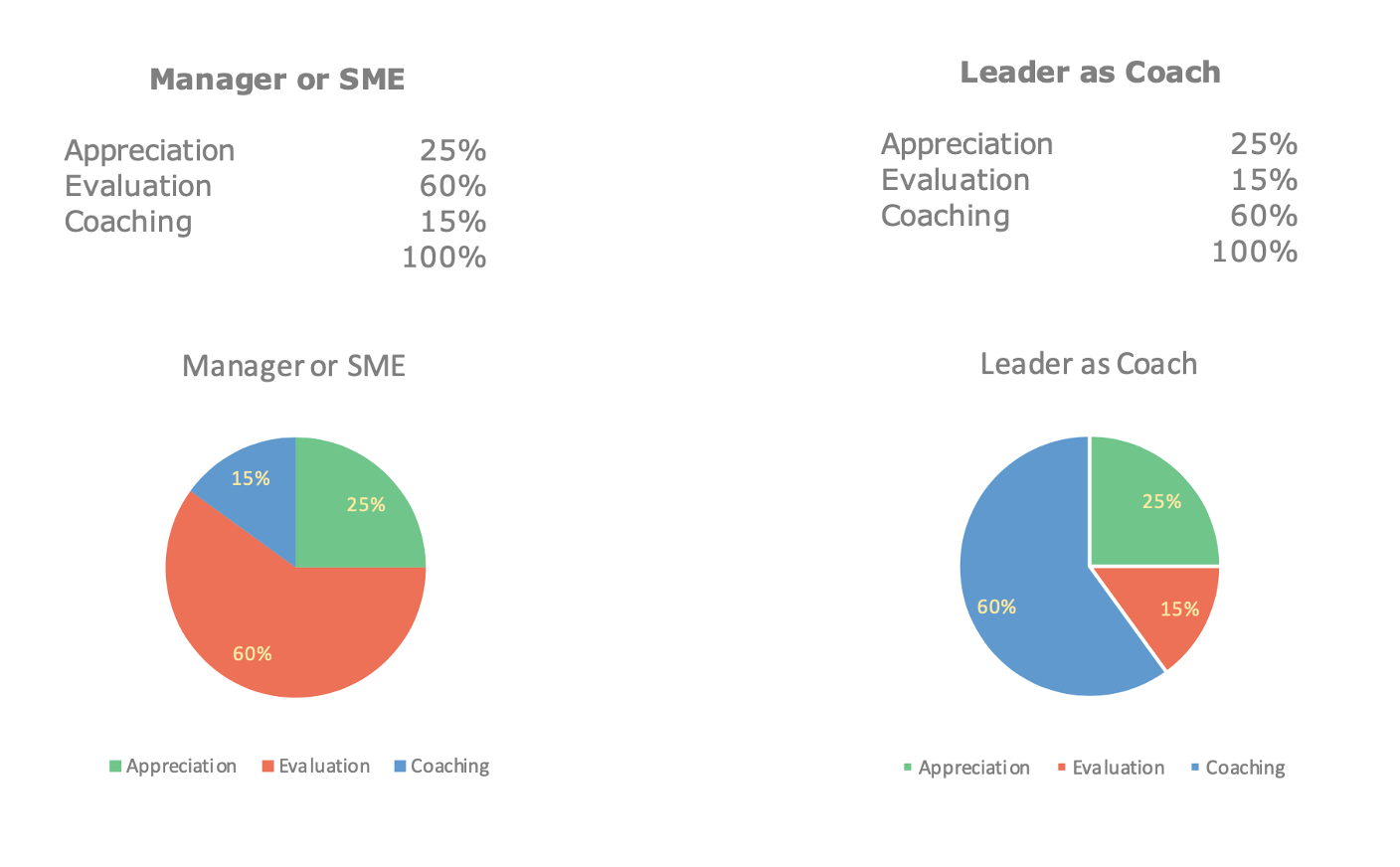
You may remember these diagrams, showcasing the three forms of feedback, from Sheila Heen and Doug Stone’s Thanks for the Feedback. Usually when we’re a manager or Subject Matter Expert, we’re focused on self, or individual skills, and are much more likely to evaluate than coach. By both sharing our leadership philosophy and genuinely learning about others, we may begin our transformation to Leader as Coach. Of course, the best evidence we’re doing this is when we are deeply listening to understand and support, in short, to lead.
We become the Career Manager as Leader
Influence & Insight | May 2026
Leadership Story | Make it Meaningful
Let’s take a closer look at the word meaningful.
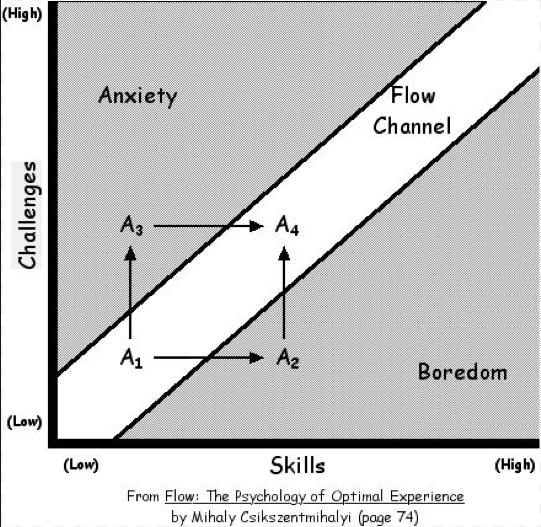
In a recent ChoinqueCast with Gallup’s Dr. Jim Harter, we reviewed one of the primary findings from Culture Shock, recommending that we should hold one meaningful conversation per week with each employee. So, what do we mean by meaningful? Sounds pretty subjective. During the podcast, Harter brought up creating a state of flow as one solution. Let’s review what flow really means.
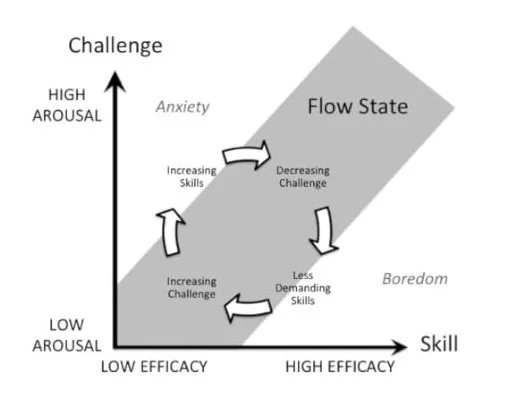
(Adapted from Mihaly Csikszentmihaly | Flow: The Psychology of Optimal Experience, page 74)
Looking at our modified flow diagram above, we will become bored as our skills grow without an increased challenge. As leaders, we should be on the lookout for boredom. Harter defined flow as requiring high challenge. This is where our role as Leader as Coach comes into play. Think of our toolbox created during a Leadership Excellence Course. Our toolbox includes:
• Understanding what motivates people (instinctive needs)
• SMART Goals
• Motivation Assessment and Plans
• Coaching Forms
• Action Plans
Altogether, this knowledge helps us define increasing challenges for others, while providing any necessary tools and training thereby increasing skills. We don’t want burnout as a result of setting the bar too high, rather we may think of coaching sessions as a means of creating and maintaining a flow state whereby our team members are so genuinely engrossed in their work time passes by with ease. This is what we mean when we say “manage energy, not time.” The result is breakthrough performance.
Leaders Make it Meaningful.
flow | Book Review
Mihaly Csikszentmihali’s (MEE-hy CHEEK- sent-mə-HY-ee) classical work offers a deeper dive for us to explore our individual goal setting, Energize2Lead profiles, and ultimately sense of purpose (Leader’s Compass). flow is not a casual read, offering numerous philosophical & psychological references and occasional sociopolitical commentary. Mihaly’s deeper explorations into such are beyond the scope of this review, and left to the individual reader for personal examination.
Flow Conditions and Goal Setting
Chapter four sets up the definition and conditions of flow, which may remind us of our (Leadership Excellence Course) High Jump analogy.
For example, as our skills grow (A1 -> A2,), we become bored, similar to performing the high jump the same way with very limited performance improvement. An increased challenge (A1 -> A3) first leads to anxiety, then return to the flow condition (A3 -> A4), but at an elevated flow level, commensurate with a “breakthrough” in high jump performance when technique is changed. After each flow experience, we are operating at a higher performance level with more complexity involved.
Happiness and the Autotelic Experience
On page 16, Csikszentmihali states:
“We grow up believing that what counts most
in our lives is that which will occur in the future.”
setting up Chapter 3, Enjoyment and the Quality of Life, by far the most powerful portion of the book. More expansive than Dan Pink’s observations of motivational elements (autonomy, mastery and purpose), Mihaly’s studies indicate, regardless of culture, social class, age, gender, or stage of modernization (page 48), enjoyment consists of:
1. A Challenging Activity That Requires Skills
2. The Merging of Action and Awareness
3. Clear Goals
4. Feedback
5. Concentration on the Task at Hand
6. The Paradox of Control
7. The Loss of Self-Consciousness
8. The Transformation of Time
Altogether, these flow conditions lead to the Autotelic Experience, or a richly rewarding life in the present, perhaps similar to Maslow’s Self-Actualization.
E2L and Leader’s Compass
On page 208, Mihaly summarizes the autotelic self, which may be perceived as a person who has been living within their Leader’s Compass, and who knows themself well. Csikszentmihali uses the term psychic energy (page 6 and onward), which is very similar to self-understanding of our expectations and instinctive E2L dimensional needs.
Or, put another way, once we know ourselves and document our Personal Leadership Philosophy, we are prepared for a lifetime of flow experiences.
Coaching Story | Coaches Accelerate Creativity
Last month’s coaching story described a very excited client and how he greatly improved weekly team meetings.
It’s a pleasure reporting that during our third (after Leadership Excellence Course) session, our client has continued improving meetings.
A lot.
This client serves as Career Manager for quite a few people. Since changing their team meeting format, especially by having others chair the meetings, the following positive feedback has been received:
• We didn’t think it was our right to run a meeting
• We’re sharing cool things each others have done
• There’s lots of value in doing this
• The tone of our meetings has changed
We also learned last month that team members are taking turns training the group on new technology applications. Turns out, this idea has really taken off. The group has created instructional manuals during ‘low bandwidth’ times. One example was improved MSWord skills.
More significantly, in last two months this cohort has exploded use of AI tools, including among other things, analyzing abstracts. Others have noticed. Our client’s program manager asked if this knowledge could be shared with other task leads. Perfect. Our client calls this emerging process a “Creativity Accelerator.” This new, organic process, is a fantastic example of widespread knowledge sharing or crossing the Knowing-Doing Gap. We’re likely to continue capturing additional stories how AI both increases knowledge sharing and team productivity.
Coaches Accelerate Creativity
Influence & Insight | April 2026
Leadership Story | Cross the Knowing-Doing Gap
In a recent Academy Leadership Excellence Course numerous discussions centered on the tendency for organizations to “Go through the motions,” rather than figure out what ought to be done in order to improve. Our cohort was a government team, and one might think going through the motions is an exclusive feature of government bureaucracies, but that’s not the case. Pfeffer and Sutton explore this tendency in The Knowing-Doing Gap. The authors observe that we seem to focus much more on knowledge than doing:
“But the view of knowledge taken by many consultants, organizations,
and management writers is of something to be acquired, measured,
and distributed — something reasonably tangible, such as patents.”
This tendency toward more processes rather than more doing accumulates what we may call administrative knowledge, which according to the authors happens when we treat knowledge as a process rather than a thing. It gets worse when applied to human interaction. Does your organization suffer from:
Crappy meetings
Sterile weekly supervisor discussions
Annual Performance Reviews with detached bosses
If during any of these events we feel like we are just going through the motions, then our organization is likely suffering from administrative leadership.
In this month’s ChoinqueCast, Chris Mattila shares what it’s like to cross the Knowing-Doing Gap at American Transmission Company (ATC). A sampling of what occurs at ATC:
• First time supervisors are informed of corporate strategy for early alignment
• A family environment, inclusive group exists
• It’s a very easy place to fit in
• Hiring takes time
•• suggesting predisposition to the special culture
•• all levels are involved
•• people performance is measured in the same way at all levels
•• a significant focus is on development
•• a supervisor’s starting point is: How can I help you?
•• everyone is open and transparent
Chris mentioned he’s found ATC unusual in the industry, and Pfeffer and Sutton would likely agree. When researching The Knowing-Doing Gap, the authors found very few organizations that had successfully crossed the gap. Perhaps the authors may highlight ATC should they update their seminal work.
Leaders Cross the Knowing-Doing Gap.
The Motive | Book Review
“If we can restore the collective attitude that leadership is meant to
be a joyfully difficult and selfless responsibility, I am convinced that
we will see companies become more successful." (p. 170)
Patrick Lencioni believes this may be his best book to date (2020) and makes a good argument in his favor. Lencioni gets right to the central point: There are only two motives that drive people to become a leader. First, they want to serve others. The second basic reason to be a leader -- the all-too-common but invalid one -- is that they want to be rewarded (p. 131). Lencioni's goal then is to expose reward-centered leadership for what it is and help leaders overcome it, for their own good and the good of the people and organizations they are supposed to be serving (p. 133).
The Motive is a fable with the following primary cast members:
• Shay Davis, recently promoted CEO of Golden Gate Security.
• Liam Alcott, CEO of Del Mar Alarm.
• Amy, of Lighthouse Partners, a consulting firm with a successful reputation.
We may think of Liam as an Academy Leadership Excellence Course (LEC) graduate, Shay Davis as the underperforming CEO who is beginning to realize something needs to change, and Amy from Lighthouse as the facilitator of Shay's prior LEC. The storyline is essentially Liam serving as a Leader as Coach, genuinely sharing with Shay what he has learned from Amy and successfully implemented at Golden Gate Security since.
Day One | Know Yourself
Day One of an LEC focuses on self-knowledge, and Liam gives it straight up to Shay: "You're the CEO of Golden Gate because you see your job as a reward." (p. 105). Liam has also done his due diligence: "You seem to have more employees generating less revenue. Your turnover, among both customers and employees, is considerably higher than ours." (p. 23) Of course, Liam is simply sharing what Amy taught him. "Everything that Amy and the other consultants at Lighthouse focused on started with me." (p. 25)
Liam continues: "You are doing the things you like to do. You aren't doing the things your company needs you to do." (p. 87) Anyone promoted to CEO has experienced this, having been highly competent in multiple areas. Shay shares that he really enjoys marketing and time with customers, not so much managing and leading (p. 30). Liam shares one of his key findings from his LEC: "I learned that I am supposed to have the most painful job in the company." (p. 58)
In his own way, Liam describes what serving others means to him: "I have the worst and best, loneliest and most social, most appreciated and most thankless job in the company." (p. 106) His question for Shay: "Don't you realize that your job is to do things that no one else in the company can do?" (p. 84)
Liam reveals what we learn on Day Two of an LEC: "You also have to be the primary communication tool." (p. 99)
Day Two | Know Others
Jolted with these revelations, Shay asks Liam: "So, you're telling me that you spend almost all of your time leading and managing your team?" (p. 36). Liam responds with regard to meetings: "It's without a doubt my favorite part of my job." (p. 40) This is one of the best parts of The Motive. If a CEO hates meetings, who's fault is it that they are crummy? Liam shared a huge learning: "Bad meetings, boring meetings, ineffective meetings were my fault and were lethal to the company." (p. 65) Upon visiting Golden Gate Security, Liam found the atmosphere to be largely stale (p. 43). Uh oh.
Liam realizes Shay has not learned what energizes, or inspires others, and has no idea how to create a motivational environment. Liam describes it this way: "Making sure they work together and aren't getting bogged down by politics and confusion." (p. 67)
Shay is also avoiding internal conflicts, rather than becoming a leader as coach. Karl and Jackie are brought up as two who don't seem to get along.
"How about interpersonal skills and attitude?" (p. 47) Liam drives the bigger point home: "But you're ignoring the impact she's (Jackie) having on others." (p. 71) Now we're learning why performance is suffering.
Day Three | Know Your Stuff | Leader as Coach
On day three of an LEC, most participants score relatively low on the Setting Leadership Priorities self-evaluation. Liam verbally explores the same with Shay: "What is the most important part of what you do?" (p. 27) Think of the Pareto Principle, or the 80/20 rule. Liam wants to know what Shay believes are his High Payoff Activities (HPAs). "I'm more curious about what you think you really do to help the business." (p. 28)
This exercise reveals the most significant difference between Liam and Shay, or what Liam is doing differently after his sessions with Amy. Shay is reluctant to delegate functional business responsibilities, and Liam shares what he has learned: "Because I have a CIO and a CTO who focus on those things. I have to be the CEO." (p. 60)
Shay unfortunately mixes up evaluation and coaching: "If I have to coach them all the time and get them to change the way they behave, then I shouldn't have hired them in the first place." (p 49) Liam counters: "The best golfers and tennis players and other athletes pay people lots of money to coach them." (p. 94). The ultimate role of a leader is to develop more leaders.
Summary | The 5 Omissions
Lencioni shares what we may consider five frequently omitted HPAs for CEOs:
1. Developing the leadership team.
2. Managing subordinates (and making them manage theirs).
3. Having difficult and uncomfortable conversations.
4. Running great team meetings.
5. Communicating constantly and repetitively to employees.
By the end of The Motive, and after demoting himself, Shay realizes: "But I'm starting to think that in a few years I might be ready to do what a CEO does." (p. 125). Maybe next time for the right reason, to serve.
“This is why it is so important for leaders to surround themselves
with people who will be honest with them.” (p. 166).
Coaching Story | Communication is Priority One
During a follow up coaching session a few weeks ago, a very excited client shared how he greatly improved weekly team meetings. Here’s some of the changes made:
Agenda Item 1: Someone on the team shares something cool they noticed a colleague do in the past week.
Agenda Item 2: Normal administrative stuff (which dominated prior meetings).
Agenda Item 3: What everyone is working on.
Agenda Item 4: Open ended discussion similar to an After Action Review (AAR)
•• What worked?
•• What didn’t?
•• How do we get better?
•• Decision making to move forward and improve.
•• Accountable individual(s) commit improvement action(s) to team.
My client was most excited with the immediate team feedback - they love all of the changes.
Another change, my client rotates among the team who actually facilitate the meetings.
During this session, the client reported that everyone on the team has facilitated the weekly meeting at least once.
They’ve taken another step forward, further increasing knowledge sharing. Team members are taking turns training the group when learning something new: it could be a policy thing, a new technology application (think AI), or just anything. Sounds like this team is crossing the Knowing-Doing Gap.
Communication is Priority One.
Influence & Insight | March 2026
Leadership Story | Leaders Make it Safe
One of the key Dialogue Skills in Crucial Conversations is Make It Safe. The authors also share that Masters of Dialogue are keenly aware of both content and conditions (Learn to Look). During a recent Virtual Leadership Excellence Course, our group of seven established a safe environment over our three days together.
Here’s a clip from our Zoom Chat feed the morning of day three, after each attendee read their Personal Leadership Philosophy aloud:
• Your leadership philosophies hit like a culture-defining highlight reel.
• Gene set the bar early, a vibrant energy, business-forward mindset, and an empowerment-first lens that made the whole room feel like we were building something healthier, stronger, and more intentional together. The way he framed "healthy space" and navigating change felt like someone who doesn't just talk transformation... he architects it.
• Jennifer brought depth. Her framing around resilience, commitment, and the "non-negotiables" of how she shows up made her feel not just aligned, but grounded. She managed to make leadership sound human and disciplined without losing the spark that makes her, well, her. It landed.
• Katrina radiated openness and humanity. There's a warmth in how she carries herself that you can feel in the room, motivating without trying, caring without bragging, the leadership equivalent of a warm mug on a cold morning. She has that "light the house" energy that stabilizes a team.
• Anita was a masterclass in ownership and sincerity. Warm, caring, generous with both vulnerability and accountability, and still anchored in strength. There's something refreshing about someone who can make leadership feel both joyful and serious without swinging too far in either direction.
• And Josh... gentle, kind, and naturally safe to be around. He came across like someone people want in their orbit, the type who brews loyalty simply by being authentic. There's real connective tissue in the way he leads; you feel it whether you're the speaker or the listener.
• Jim wrapped the whole thing with playful eloquence, descriptive, intentional language paired with a philosophy built on respect, optimism, and leaving every space better than you found it. It was personal, grounded, and surprisingly moving. One of those presentations that stays with you.
• Walking out of this session felt like joining a ship where every captain actually knows where they're steering, and does it with heart! It's rare to step into a room full of leaders and feel genuinely inspired by every single one. But that's what happened.
One of the keys to Making it Safe is leading discussions that keep people sharing. Our group of seven, we Summit Sentinels, found a way to open up, fearlessly share, and ultimately create a lasting lifetime experience. A snippet from our program feedback:
“It’s rare to be in a space where leaders are this honest about who they are, how they show up, and where they’re trying to grow. Every session felt less like training and more like a reset button. A chance to strip things down and rebuild with intention. What moved me the most was hearing everyone’s stories. You realize fast that each person here is carrying something, pushing to elevate their teams, protect their culture, and become a better version of the leader they started as. The honesty, the vulnerability, the accountability… you simply don’t get that in most workplaces. I’m genuinely grateful to have experienced it alongside peers I deeply respect.”
A hat tip is in order to the Summit Sentinels, Masters of Dialogue.
Leaders Make it Safe.
The Character Edge | Book Review
“Now colleges and universities, along with the military and
private corporations, are systemically integrating character
assessment and development into how they select, educate,
train, and develop their students and employees (p. 5).
Subtitled Leading and Winning with Integrity, this work merges the military excellence experience of Lt. General Robert L. Caslen, Jr. (ret.) with the academic excellence experience of Dr. Michael D. Matthews, Professor of Psychology, West Point. The pair define character as:
"a person acting on his or her world in ways that benefit it and, in turn,
the world thereby providing benefits for the person (pp. 7-8).
The Character Edge opens by referencing Seligman and Peterson, who identified twenty-four character strengths that are common in the human species, and further classify these into six overarching categories called moral virtues (pp. 11-12):
• wisdom and knowledge
• courage
• justice
• humanity
• temperance
• transcendence
This review recommends The Character Edge as an effective reference for developing an authentic Personal Leadership Philosophy, or PLP. This may be done in two ways: Using a Character Strengths Survey and aligning the top character findings with an Energize2Lead (TM) (E2L) Profile. Selected examples of both military experience and measurement & experimental design complete are also highlighted.
Assess | Character
Two character strength assessments may be used -- the first may be found on pages 13-16. Peterson and Seligman provide a second, more systematic way of assessing character strengths -- the Values-in-Action Inventory of Strengths (VIA-IS), which may be found on-line at no charge (p. 16):
VIA Survey of Character Strengths
Choose one and complete the survey. Peterson and Seligman believe it is particularly instructive to look at your top five or six strengths, which they refer to as signature strengths (p. 16). Note that the six columns, from left to right, correspond to the moral virtues transcendence, temperance, justice, humanity, courage, and wisdom and knowledge, respectively.
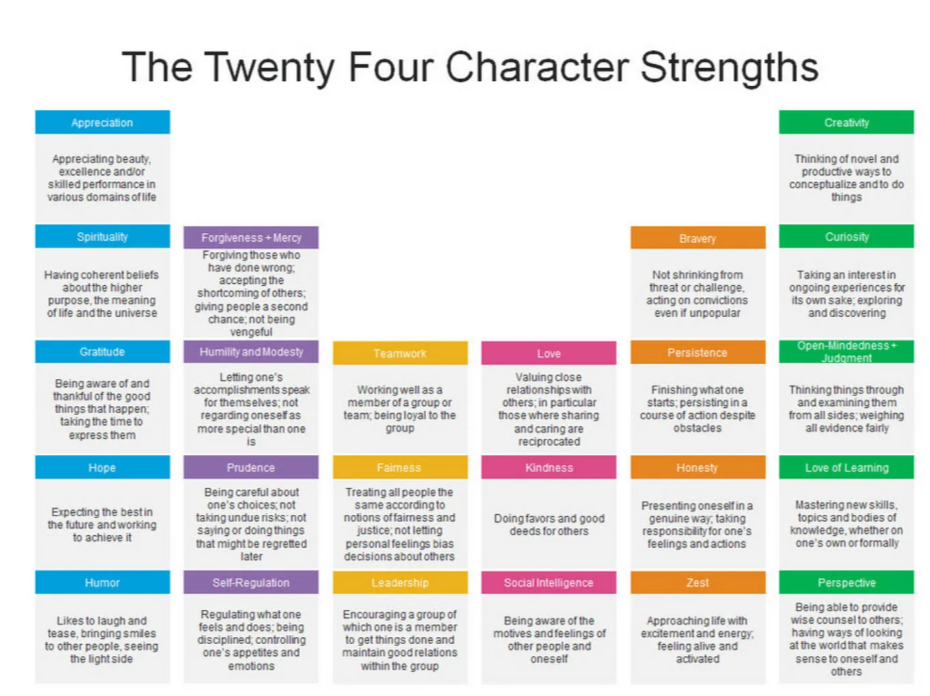
Source : https://www.linkedin.com/pulse/do-you-have-character-strengths-ray-williams-rdfec/
We can think of the signature strengths as our personal values, or what we believe in, as an essential starting point drafting our leadership philosophy.
Align | Energy
Caslen and Matthews recommend we keep in mind that we intuitively turn to specific strengths of character depending on the situation in which we find ourselves (p. 17). Recall from our E2L Workshop that we may think of our intuitive tendencies as the colors in the instinctive (lower) dimension of our profile; or our motivational needs, our learning style, our survival instincts, and what we tend to listen for.
Let's return to our personal values, or signature strengths and put them to the test. Are these the primary traits we turn to when tested, or under stress? If the answer is no for any of our top survey results, we should consider selecting another strength.
Lead | Live Our Strengths
The authors break down individual and organizational attributes vital to effective leadership into character strengths of the head, heart and gut -- respectively pertaining to good thinking, compassion for others, and courage (p. 23). These three character strengths comprise three central chapters of the book, or how to walk the talk. Key examples follow:
Strengths Of The Gut (Courage)
Psychologists Paul Lester and Cynthia Pury point out three factors that must be present of an act to be considered courageous (pp 29-33):
• Free Choice (Volition)
• Noble or Worthy Goal
• Significant Personal Risk
The authors highlight, among others, Captain Barry Bridger, a Vietnam War F-4 Phantom fighter pilot who was shot down 23 January 1967 and endured 2,232 days as a prisoner of war (POW). His Silver Star citation illustrates what he endured while recognizing his character strength of devotion to duty to enable him to persevere under such conditions (pp. 26-27).
Strengths Of The Head (Good Thinking)
Psychologist Robert Sternberg found that overall intelligence breaks down into three subtypes: analytical, creative, and practical. Another psychologist, Howard Gardner, identified eight (more specific) types of intelligence: linguistic, logical-mathematical, spatial, musical, bodily-kinesthetic, interpersonal, and naturalistic (pp. 58-59).
Caslen reflects on second lieutenant Sam Ketchens, who the general knew as a rugby player at West Point and successfully integrated the Sons of Iraq into the Iraqi Army by negotiating, reasoning, and winning the support of his Iraqi Army counterparts and got these former insurgents the support, equipment, and rations they needed (pp. 66-67).
Strengths Of The Heart (Compassion For Others)
Cultural anthropologist Janice Harper writes:
"If a man (Nelson Mandela) tortured and imprisoned for nearly
three decades could find in himself forgiveness, what lessons
might we take from him on how to respond to acts of
aggression and cruelty in our ordinary lives?" (p. 92)
The authors call out Gratitude as one of the most powerful strengths of the heart: The greatest thing about gratitude is that practicing it may bring greater positive benefits for you than it does for the recipient of thanks (p. 93).
Dr. Matthews recalls mentoring a cadet who had been arrested for driving while intoxicated, and rather than separation from West Point, was placed in a formal and rigorous mentorship program. A few days before the cadet's graduation he penned a deeply meaningful letter of gratitude (pp. 93-94).
Summary
The best evidence that we are authentically living our leadership philosophy is when our stories accumulate over time, just as with Caslen and Matthews.
Character must be continuously developed. It is not something you
have or don't have. Even people considered to be icons of character
sometimes fail to behave morally or ethically (p. 184).
LTG Caslen generously provided a copy of his book for review.
Coaching Story | Leaders Care
During a recent coaching session, a client shared repeated feedback that she was “too emotional,” and was concerned this reflected poorly on her as a leader. Maybe she is too emotional and maybe she is not. It’s worth revisiting recent findings and trends in the workplace, especially since the lates Gallup findings (we covered this in the past couple months) indicate corporate engagement scores have been dropping, essentially losing all of the gains perhaps made possible via increased autonomy (i.e. working from home) during Covid.
Let’s look the well-known Gallup Q12 Survey Questions focused on employee engagement:
1. Do you know what is expected of you at work?
2. Do you have the materials and equipment to do your work right?
3. At work, do you have the opportunity to do what you do best every day?
4. In the last seven days, have you received recognition or praise for doing good work?
5. Does your supervisor, or someone at work, seem to care about you as a person?
6. Is there someone at work who encourages your development?
7. At work, do your opinions seem to count?
8. Does the mission/purpose of your company make you feel your job is important?
9. Are your associates (fellow employees) committed to doing quality work?
10. Do you have a best friend at work?
11. In the last six months, has someone at work talked to you about your progress?
12. In the last year, have you had opportunities to learn and grow?
Several of these certainly concern our emotional state — questions 3, 4, 5, 8 and 10 come to mind.
In Wellbeing at Work, the authors (Jim Harter and Jim Clifton) define a net thriving culture as one that improves people’s lives and performance - beyond typical wellness programs. Note the definition lists lives before performance. In Harter and Clifton’s most recent book, Culture Shock, the overall message may be summarized:
“Make sure your managers hold one meaningful conversation per week with each employee.”
Or put more simply, employees want coaches, not bosses.
Most recently, we revisit Mark Crowley’s The Power of Employee Well Being. Crowley calls for updated metrics for any professional concerned about organizational performance. His work is an intentional pivot toward elevating well-being in order to help solve two rather significant problems facing businesses today:
• Chronic employee burnout.
• Not effectively supporting employee’s emotional and psychological needs.
During our session, we revisited these points. It was also worth mentioning that focusing on employee well-being doesn’t mean being unassertive. Recall from our Leveraging the Power of Conflict workshop’s Conflict Leadership Strategies, there are times when we should compete (think defending core values or non-negotiables) and our ideal strategy is collaboration, both assertive and cooperative.
Leaders Care.
Influence & Insight | February 2026
Leadership Story | Our Leadership Philosophy Matters
Jim Harter, Chief Scientist, Workplace for Gallup, recently penned U.S. Employment Engagement Declines From 2020 Peak.
Selected key takeaways:
• Younger workers are experiencing the biggest drops in engagement. Between 2020 and 2025, younger U.S. workers experienced the largest drops in engagement. The percentage of Generation Z and younger millennials who are engaged at work dropped by eight points, while older millennials (born 1980 to 1988) dropped by nine points. Generation X declined in engagement by six points, and baby boomers saw no change in engagement since 2020.
• Generation Z and younger millennial employees were 13 points less likely in 2025 (41%) than in 2020 (54%) to strongly agree with the statement “My supervisor, or someone at work, seems to care about me as a person.” Agreement with the statement “This last year, I have had opportunities at work to learn and grow” also fell 11 points, to 37% from 48% in 2020.
• Decline in Employee Engagement Comes Down to Basic Needs: Communication, Respect. Clarity about what is expected at work and feeling cared about as a person show the largest declines among Employee Engagement Index items since 2020 for all U.S. employees (nine and eight points, respectively). The qualitative data showed that U.S. workers are seeking more communication about both the direction of their company and their own individual development. For example, one employee said that one thing that would clarify expectations is “greater transparency from management regarding firm strategy, goals and decision-making.” Other respondents focused more locally: “Communication from management and conversation on where my career and the department are going” and “more regular, consistent communication from my manager.”
• What Leaders Can Do in 2026. Employee engagement has declined after a decade of steady improvement leading up to the COVID-19 pandemic. The data suggest that many of the gains organizations made in clarifying role expectations, developing people and improving the day-to-day experience at work have stalled — and, in some cases, have begun to reverse. Younger workers appear particularly vulnerable in this environment, as they are more likely to be early in their career and more dependent on clear expectations, feedback and development.
We learned in Culture Shock that we should lead not manage, and that we should make sure managers hold one meaningful conversation per week with each employee.
Harter’s findings suggest we should reexamine our Personal Leadership Philosophy, or PLP. For example, does our PLP envision a positive, inspiring vision that answers the question “Where are we going?” Also, how clearly are we describing our expectations, both what we expect from everyone on the team, and more importantly, what may individuals expect from us as a leader. Listening to hundred of PLPs over the years, describing the future and in clarifying in some detail, what individuals may expect from us are frequently sections of the PLP in most need of improvement.
For example, if our PLP is in effect, defining leadership as a program or project that is completed on time and under budget, that’s a manager’s expectation, not an inspiring future vision igniting a team. Likewise, a statement such as “I have an open door policy,” doesn’t confer any initiative upon the leader to learn about others as an individual, care about them, or indicate a commitment to serve as a leader or coach.
Additional books such as Wellbeing at Work and The Power of Employee Well-Being offer more simplified, and perhaps more practical ways for we as leaders to approach and increase engagement, than Gallup’s well known Q12 Employee Engagement Survey.
Gen Z is putting leaders on notice. The next generation wants coaches not bosses.
Our Leadership Philosophy Matters.
My Space Station Story | Book Review
“Let the future amaze you. You cannot know it,
so embrace its possibilities." (p. 241).
Subtitled A Personal Story About Growth, is Mike Varga's personal story -- is not penned as a "Leadership Book." On page 10, Varga admits to a lack of management or leadership education early in his career. Reviewer disclosure: Mike's path and mine crossed years ago, in Glendale, AZ, if memory serves, and the most lasting impression was that of an innovator who created the Prototype Development Unit (PDU), introduced on page 111.
This review makes the case that whether intentional or not, Varga has created a Personal Leadership Philosophy (PLP). Recall from our Leader's Compass workshops, a PLP consists of nine elements:
• What Leadership Means
• Personal Values
• Top Priorities
• Operating Principles
• Expectations
• Non-negotiables
• Pet Peeves
• Personal Idiosyncrasies
• Commitment
Varga's story is a blend of personal and business autobiography, summarized as Lessons Learned and Conclusions in Chapter 26. By tracing his twenty five summary points, and their respective positions in his book, we may sequence the following:
My Space Station Leadership Philosophy
To be the leader of an organization means that you not only have to have great communication skills, you have to have the ability to take in massive amounts of data and filter it into meaningful information from which would inform useful conclusions (p. 59). Being able to properly define a problem helped me develop some of the leadership skills essential to many future challenges (p. 35). Being curious, open to new things and willing to be surprised made the journey of my career and my future interactions with the Space Station great fun! (p. 26)
Truly nothing is done alone; every worthwhile adventure is accomplished with the assistance of many (p. 196). Use what already works, seek to use, where you can, existing products and capability to reduce the development time, the development cost and the risk of overruns (p. 108). The ability to concentrate and work through to solutions requires commitment. The difference between anxiety and commitment is that one is destructive, the other constructive (p. 61). A lesson I learned from those early days of Space Station pursuit, was to sell large projects internally as well as externally (p. 175).
Use your powers of visualization. Have a knack for transitioning words to equations, from ideas to something that is implementable. (p. 20). Losing is a necessary ingredient of success (p. 236). Don't delay when you feel something is not right. Even if the customer is being an ass, there may be more to it than the customer being unreasonable (p. 158). It is seldom that you have an 'ah ha' moment in business, and it is only possible by being in the right place at the right time, by being prepared and open minded (p. 171).
The written and oral language is essential for solutions. Only through this path can we transition toward engineered solutions (p. 20). Nothing in the world can prepare you for losing the first really big business battle (p. 99). Brush yourself off, get back up and find the next battle (p. 101). Challenging decisions with a question goes down much easier (p. 171). There is no substitute for those accountable for an organization's performance to put eyes on the delivered product on important occasions (p. 240).
Big programs are one third technical, one third financial, and one hundred percent political (p. 74). When you are in an organization, there's no such thing as a casual conversation with executive leadership, and even getting a burger and a beer can be life changing (p. 132). Age and experience do not always lead to performance (p. 158).
Reading out loud what I've written informs me if my message was clear (p. 24). Macroeconomic and world events do affect all businesses in some way; no one is on an island (p. 190).
Needing help may be a sign of some weakness but asking for, and getting help is a strength (p. 16). I learned a lesson about getting the right kind of support, about properly sequencing activity and being in control. I hate not being in control (p. 104). Don't assume you know the answer. Ask the question and learn (p. 171).
Summary
Quite a leadership journey indeed.
Our team was forced to examine what we were doing and why, in
the context of the demands of the market place. This self-analysis
and consideration are absolutely critical to realizing growth from a
manager of processes which were handed down over the year, to
being a leader capable of inventing and molding processes to
achieve vision and objectives (p. 150).
Mike Varga generously provided a copy of his book for review.
Coaching Story | Leaders Hire for Values
Increasingly the word predisposed seems an invaluable term for a leader building an organization. Let’s connect predisposition with decision making and our core values.
During Academy Leadership Graduate Leadership Courses, it’s been useful playing a brief video clip where Jim Collins, Tony Hsieh & Steve Jobs discuss core values. The video may be viewed on Facebook here:
The video starts with Collins mentioning that people often ask him “How do you get people to share core values?” Collins answer is “You don’t.” He goes further declaring we can’t install new core values in people and that instead we should find people who already have a predisposition to sharing our values. Hsieh goes further in the second video segment, in a way challenging us to make hiring and firing decisions solely based on our core values, rather than simply displaying core values as offered by our marketing department.
This month a colleague and protégé shared that she had to let go of one of the first to join her start up. This was obviously a tough decision especially since my colleague hired a long time friend. Upon reflection, she realized friendship is a poor basis for hiring, especially in the early stages of a company. What’s a better way? We can certainly start with Collins’ and Hsieh’s advice to consider core values alignment. Let’s call that the first criteria. Collins offers four additional things to consider when looking for the right people:
1. Find people who are already predisposed to our core values — already inside them, latent perhaps, or maybe they’re already ignited.
2. A right person on the bus is not somebody whom you need to manage.
3. In key positions, do they have exceptional capability, defined as the following: in the seat that they hold, could they potentially be one of the best in the industry, or one of the best in the field in which your organization operates, in that particular seat?
4. The individual understands the difference between having a job and a responsibility.
5. If it were a hiring decision all over again, given everything that you know, having worked with this person, would you still hire them?
In the third video clip, Jobs realizes upon returning after a twelve year absence from Apple, that what makes Apple distinctive ultimately comes down to core values, not just world class technical talent.
Our video concludes with Collins returning to his second hiring consideration: “The right people don’t need to be tightly managed. The right people are self-disciplined, self-motivated, self managed, self learners, etc… and as we learned in From Good to Great, the moment you feel the need to tightly manage someone, you might have made a hiring mistake.”
In the next conversation with my protégé we’ll likely talk about improved hiring considerations, and how well each of these are reflected in her Personal Leadership Philosophy.
Leaders Hire for Values.
Influence & Insight | January 2026
Leadership Story | The Power of Introverts
A recent Wall Street Journal (23 Dec behind paywall):
brings up introverts and their challenges in most work environments. Ray Smith’s article primarily focuses on creating quiet spaces, similar to the quiet tents found at Autism Speaks’ fund raising walks. Smith highlights that:
• Bristol-Myers Squibb has created a room designed to help introverts recharge.
• Bristol-Myers Squibb has created a room designed to help introverts recharge. Bristol-Myers Squibb
• Bristol-Myers Squibb created a room where introverts can recharge. Its Valuably Quiet program, launched in 2021, also includes discussion panels and resource guides to help leaders and team members better understand introverts, who tend to shrink from public performance and get flustered when put on the spot.
In our Energize2Lead (TM), or E2L workshops, dominant two-color combinations are assigned the following descriptors:
Red | Yellow
Yellow | Blue
Red | Blue
Green | Blue
Green | Red
Green | Yellow
Extrovert
Right Brained
Individualistic
Introvert
Left Brained
Conforming
Having processed thousands of E2L profiles from a dozen countries, the term Introvert increasingly appears a simplified label, perhaps leading to simplified attempts to understand what energizes those with this temperament. Consider the alternative descriptor Information Processor rather than Introvert. Use of the alternative term Information Processor allow us to understand the why behind the visibly quiet personality.
Susan Cain, author of Quiet, offers a similar perspective. “Approach those people and say, ‘Today, we’re going to be talking about X, and I know you have a lot of interesting thoughts on that. Can I look to you during that part of the meeting?’ That way, you’re giving the person advance notice to prepare what they might want to say.”
Empirical observations of organizational functional teams over the years reveals that Information Processors frequently migrate to professions where accuracy is highly valued, if not required. Examples include finance, accounting and procurement. Scientists seem to frequently have these traits as well. Researchers too.
Smith’s article includes a recent Glassdoor poll of 800 professionals on introvert-friendly workplace attributes and a remote or flexible work policy overwhelmingly was No. 1, with over 60% of respondents rating flexibility first.
• Remote or hybrid flexibility
• No mandatory social events
• Quiet spaces in the office
• Async work encouraged
We should consider why remote or hybrid flexibility is the dominant first choice. Perhaps it’s all about the autonomy, or the ability to independently choose an individual schedule that affords time to fully process information leading to thoughtful and accurate outcomes. Effective leaders understand and appreciate this ability, it’s a superpower.
The Power of Introverts.
Blindspotting | Book Review
“Traditional approaches to leadership -- those based
on hierarchical decision-making and controlling
information flow -- are no longer sufficient." (p. 8)
Kirstin Ferguson's most useful term, blindspotting, relates to many activities required for us to become effective leaders as coaches. Her definition:
"Hidden gaps in our thinking and decision-making
that can have profound consequences." (p. 7)
which rest on three key mindsets (pp. 9-10):
• Be honest
• Be curious
• Be flexible
Early in an Academy Leadership Excellence Course, our audiences are asked what percentage of executives believe they are good communicators. We discover that 87% of executives believe they are, while only 17% of their subordinates think so (according to the Tom Peters Group). We may think of blindspotting as a method of reducing substantial, yet common gaps in our perceived versus actual communication effectiveness.
This review weaves selected blindspotting techniques to key teachable points of view discovered in several of our leadership workshops.
Managing a Leader's Style and Energy (E2L)
Dominant (two or three) yellow and blue colors are very common in our Energize2LeadÒ (E2L) expectations dimension. This means most of us don't want to be told what, when and how to do things. Ferguson describes two archetypes in the practice of blindspotting: Seekers and Knowers (p. 41). For seekers, the pursuit of knowledge is far more important than the need to appear knowledgeable (p. 42). Knowers tend to hold firm to their opinions, even when faced with clear evidence to the contrary (p. 45).
We can easily imagine the expert manager (Knower) telling us how to do our job, while continuously monitoring or micromanaging us throughout a project. Rather, as effective leaders, we should remain curious and flexible, as a Seeker.
Feedback: The Essential Connection
From Sheila Heen and Doug Stone, we learn of three forms of feedback in our corresponding workshop: Appreciation, evaluation and coaching.
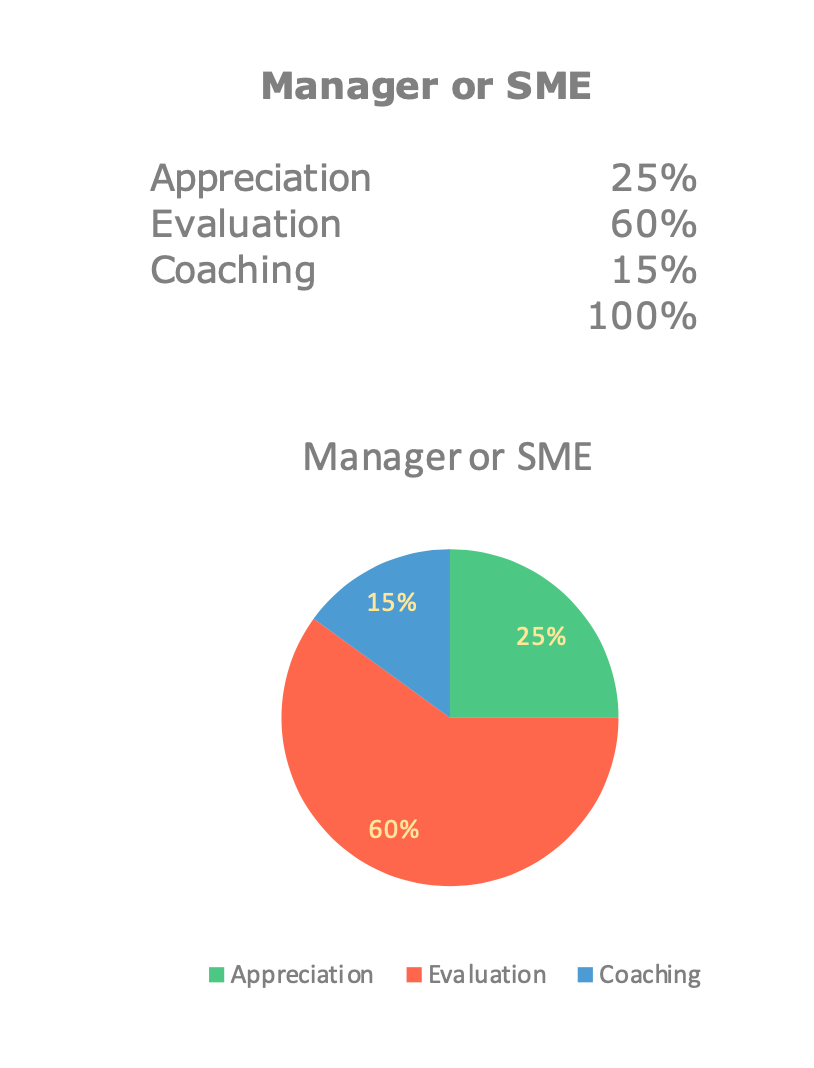
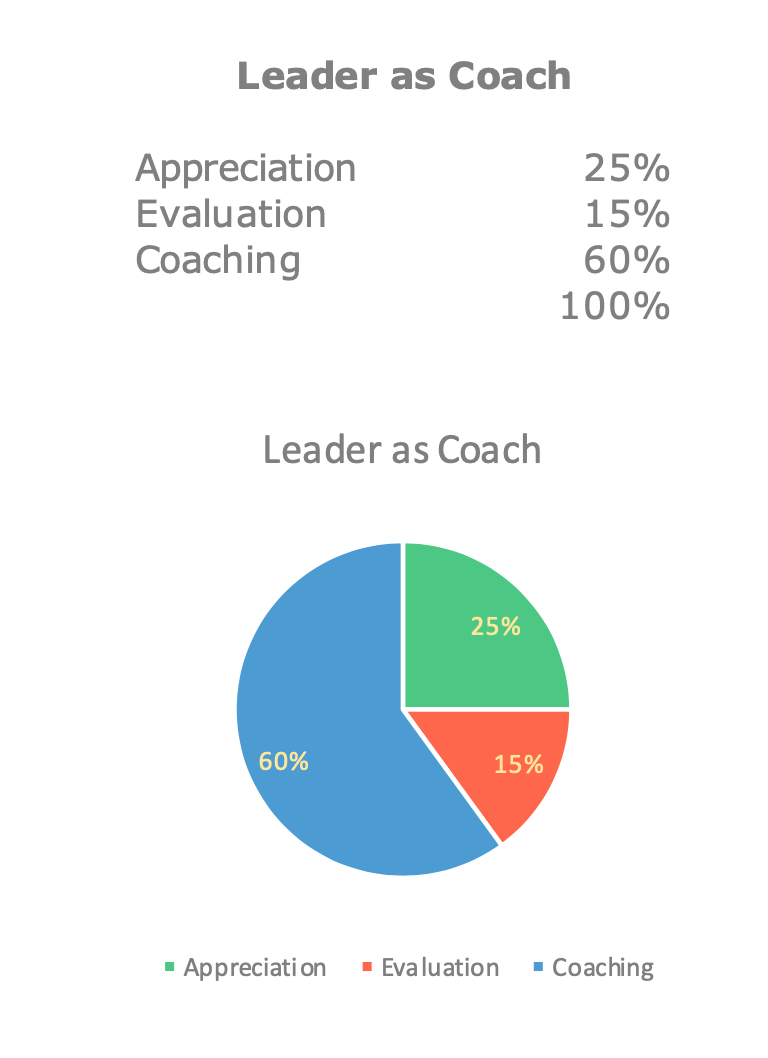
Note the typical manager or Subject Matter Expert (SME) feedback profile, where evaluation is four times as prevalent as coaching. Ferguson relates a scandal at the UK Post Office based on the perceived expertise of a computer software program called Horizon. It's a damning story. Even when whistleblowers within Fujitsu began to raise concerns in 2015, and legal actions started stacking up, the leadership team remained steadfast (p. 62).
Effective coaches ask good questions, seeking honest feedback as well as new ideas.
Leveraging the Power of Conflict
During our conflict workshop, we learn the most prized strategy is collaboration, although this technique requires the most time and energy. We also learn that one of the best uses of collaboration is when our objective is to learn, or to seek. Indeed, curiosity seems an underutilized leader superpower. Ferguson shares that curiosity opens the door to new possibilities, not by passively waiting for answers but by actively searching for them (p. 118).
Consider a leadership team fearful of new ideas, or different perspectives. Groupthink occurs when the desire for harmony or conformity in a group leads to poor decision-making, as dissenting voices are suppressed to maintain unity (p. 131).
Coaching to Develop People
In our coaching workshop, we learn the following characteristics of effective coaches:
• Base coaching relationship on trust
• Optimist about human nature
• Encourage people to take risks and learn from their mistakes
• Listen more than they talk
• Provide candid feedback in the right size dose
• Cultivate personal accountability
• Know their strengths and limitations
• Are continuous learners
Similar to the learning objective strategy, effective coaches continuously seek new knowledge. For this to occur, leaders must master both content and conditions or make the environment safe (see Crucial Conversations). Insightful questions are often open-ended, meaning they do not have simple yes or no answers, and they encourage people to think more deeply and express their thoughts in way they might not have initially considered (p. 135).
Summary | Application | After Action Reviews
In Chapter 9, Ferguson mentions that blindspotting is at its most powerful when it is part of an organization's values and mission (p. 243). She cites several organization's values and suggests possible structural changes. We may not all have the ability to do that, however an easy way to practice blindspotting with core values in mind is introducing After Action Reviews (AAR) to our teams.
Central to any AAR is a neutral, non-evaluative approach focused on objective discovery of what actually happened. The best AARs invite and welcome brutal honesty, which requires that the leader (facilitator) maintain all three key blindspotting mindsets:
• Be honest
• Be curious
• Be flexible
Blindspotting is demonstrated well by the Johari Window, also shared during our feedback workshop:
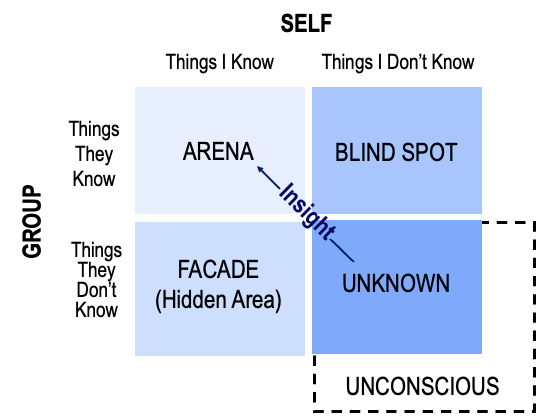
Source: Academy Leadership Feedback - The Essential Connection Workshop
Our objective is both soliciting and offering honest feedback. In addition to reducing our leadership blind spot, what we're really after is discovery, or moving knowledge from the unknown quadrant into the arena, for all to discover and share.
"By practising blindspotting, we create an environment where our
teams feel valued and heard, where everyone's perspective is taken
into account, and where creativity and innovation can thrive." (p. 12)
Coaching Story | The Nurturing Superboss
College football playoff season is upon us, and many of us are rooting for a favorite team or coach. Andrew Beaton and Rachel Bachman interestingly have found that Nick Saban is still dominating college football two years after his retirement (behind WSJ paywall):
https://www.wsj.com/sports/football/nick-saban-college-football-playoff-0e18ec32?mod=Searchresults&pos=1&page=1
Yes, it was impossible to resist another WSJ article this month. It turns out, according to Beaton and Bachman, that five of the eight surviving teams are led by Saban’s former assistants:
• Kirby Smart
• Dan Lanning
• Pete Golding
• Curt Cignetti
• Mario Cristobal
Georgia
Oregon
Ole Miss
Indiana
Miami
There’s a perfect term for this, Nick Saban is a Superboss. Sydney Finkelstein’s appropriately titled book, Superbosses, traces genealogical “trees:”
“If you looked at the top fifty people in these industries, you would find that perhaps fifteen or twenty had once
worked for or had been mentored by one or a few talent spawners – or ‘superbosses.’”
Superbosses fall into three distinct patterns: Iconoclasts, who care about their work and their passion, such as Miles Davis, and are often artistic. Next are the Glorious Bastards, who care solely about winning, and know they need the best people to win, such as Larry Ellison, who has spawned a breadth of talent in Silicon Valley. Last, are the Nurturers, or activist bosses, who consistently guide and teach their protégées, such as Bill Walsh. Clearly Nick Saban is a fellow nurturer alongside the former 49ers coach Bill Walsh.
Finkelstein notes that superbosses look fearlessly in unusual places for talent and lavish responsibility on inexperienced protégés, taking risks that seem foolish to others. He also notices many of the best bosses today tend to think of themselves as professional managers, not leaders, and confesses his biggest discovery over time studying organizations is it really is about the people.
Which type of superboss do you most resemble? If you are developing a strong leadership pipeline for the future, maybe you are a superboss.
Maybe a Nurturing Superboss.