
Blindspotting | Book Review
“Traditional approaches to leadership -- those based
on hierarchical decision-making and controlling
information flow -- are no longer sufficient." (p. 8)
Kirstin Ferguson's most useful term, blindspotting, relates to many activities required for us to become effective leaders as coaches. Her definition:
"Hidden gaps in our thinking and decision-making
that can have profound consequences." (p. 7)
which rest on three key mindsets (pp. 9-10):
• Be honest
• Be curious
• Be flexible
Early in an Academy Leadership Excellence Course, our audiences are asked what percentage of executives believe they are good communicators. We discover that 87% of executives believe they are, while only 17% of their subordinates think so (according to the Tom Peters Group). We may think of blindspotting as a method of reducing substantial, yet common gaps in our perceived versus actual communication effectiveness.
This review weaves selected blindspotting techniques to key teachable points of view discovered in several of our leadership workshops.
Managing a Leader's Style and Energy (E2L)
Dominant (two or three) yellow and blue colors are very common in our Energize2LeadÒ (E2L) expectations dimension. This means most of us don't want to be told what, when and how to do things. Ferguson describes two archetypes in the practice of blindspotting: Seekers and Knowers (p. 41). For seekers, the pursuit of knowledge is far more important than the need to appear knowledgeable (p. 42). Knowers tend to hold firm to their opinions, even when faced with clear evidence to the contrary (p. 45).
We can easily imagine the expert manager (Knower) telling us how to do our job, while continuously monitoring or micromanaging us throughout a project. Rather, as effective leaders, we should remain curious and flexible, as a Seeker.
Feedback: The Essential Connection
From Sheila Heen and Doug Stone, we learn of three forms of feedback in our corresponding workshop: Appreciation, evaluation and coaching.
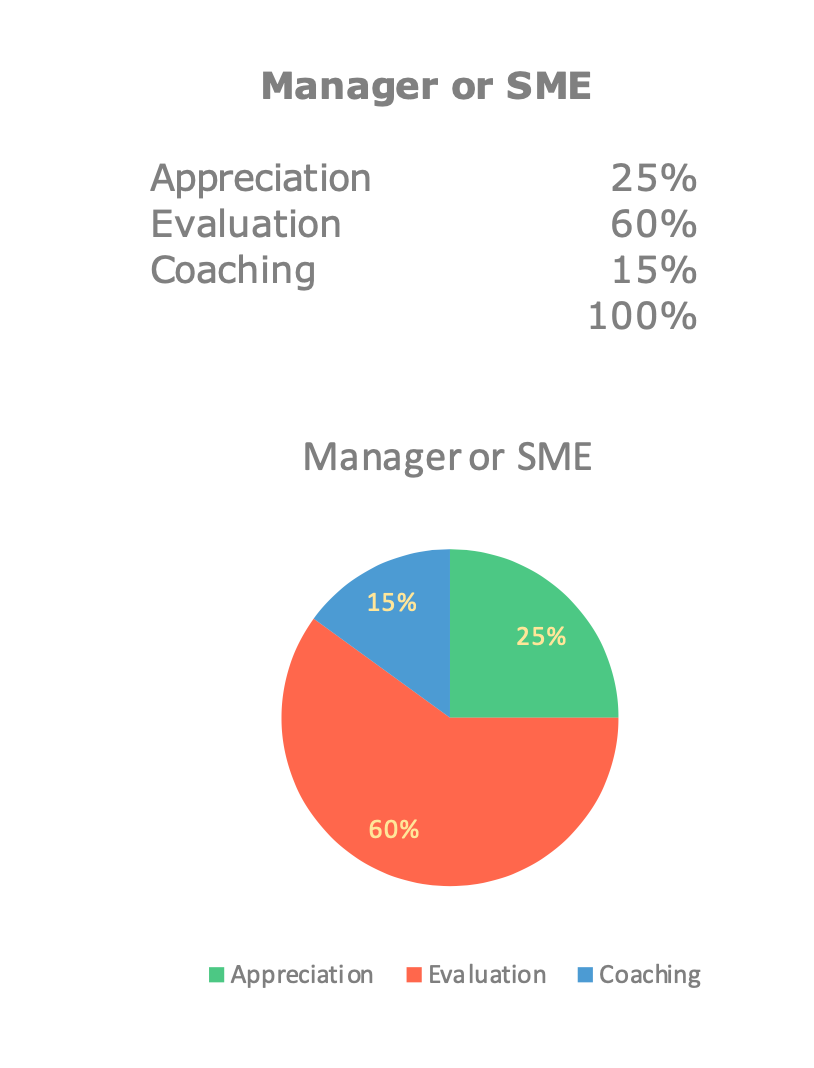
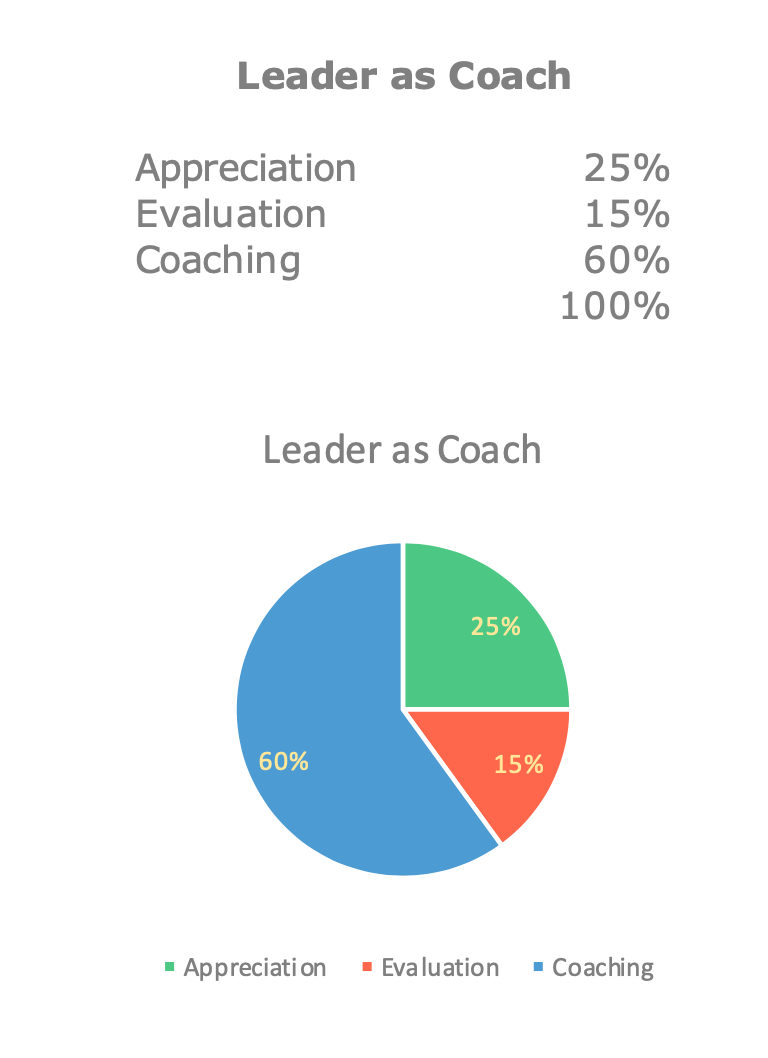
Note the typical manager or Subject Matter Expert (SME) feedback profile, where evaluation is four times as prevalent as coaching. Ferguson relates a scandal at the UK Post Office based on the perceived expertise of a computer software program called Horizon. It's a damning story. Even when whistleblowers within Fujitsu began to raise concerns in 2015, and legal actions started stacking up, the leadership team remained steadfast (p. 62).
Effective coaches ask good questions, seeking honest feedback as well as new ideas.
Leveraging the Power of Conflict
During our conflict workshop, we learn the most prized strategy is collaboration, although this technique requires the most time and energy. We also learn that one of the best uses of collaboration is when our objective is to learn, or to seek. Indeed, curiosity seems an underutilized leader superpower. Ferguson shares that curiosity opens the door to new possibilities, not by passively waiting for answers but by actively searching for them (p. 118).
Consider a leadership team fearful of new ideas, or different perspectives. Groupthink occurs when the desire for harmony or conformity in a group leads to poor decision-making, as dissenting voices are suppressed to maintain unity (p. 131).
Coaching to Develop People
In our coaching workshop, we learn the following characteristics of effective coaches:
• Base coaching relationship on trust
• Optimist about human nature
• Encourage people to take risks and learn from their mistakes
• Listen more than they talk
• Provide candid feedback in the right size dose
• Cultivate personal accountability
• Know their strengths and limitations
• Are continuous learners
Similar to the learning objective strategy, effective coaches continuously seek new knowledge. For this to occur, leaders must master both content and conditions or make the environment safe (see Crucial Conversations). Insightful questions are often open-ended, meaning they do not have simple yes or no answers, and they encourage people to think more deeply and express their thoughts in way they might not have initially considered (p. 135).
Summary | Application | After Action Reviews
In Chapter 9, Ferguson mentions that blindspotting is at its most powerful when it is part of an organization's values and mission (p. 243). She cites several organization's values and suggests possible structural changes. We may not all have the ability to do that, however an easy way to practice blindspotting with core values in mind is introducing After Action Reviews (AAR) to our teams.
Central to any AAR is a neutral, non-evaluative approach focused on objective discovery of what actually happened. The best AARs invite and welcome brutal honesty, which requires that the leader (facilitator) maintain all three key blindspotting mindsets:
• Be honest
• Be curious
• Be flexible
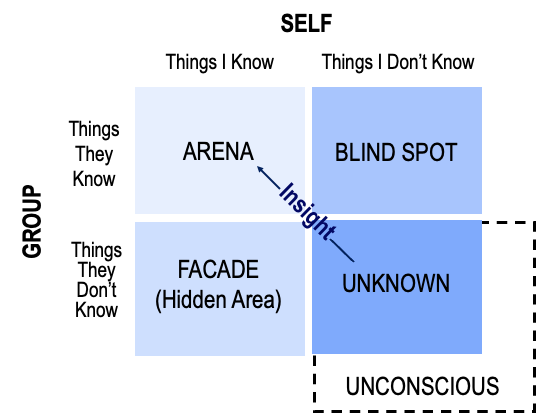
Blindspotting is demonstrated well by the Johari Window, also shared during our feedback workshop:
Source: Academy Leadership Feedback - The Essential Connection Workshop
Our objective is both soliciting and offering honest feedback. In addition to reducing our leadership blind spot, what we're really after is discovery, or moving knowledge from the unknown quadrant into the arena, for all to discover and share.
"By practising blindspotting, we create an environment where our
teams feel valued and heard, where everyone's perspective is taken
into account, and where creativity and innovation can thrive." (p. 12)
JE | December 2025
